

 |
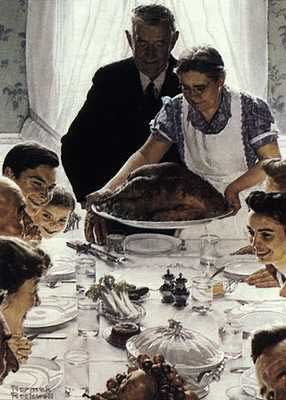
| Freedom from want |
As we enter this Thanksgiving Day, we are drawn to thoughts of hearth, home , family and family of the heart.
Though the faces, the hairstyles, the clothing may seem old-fashioned, the Norman Rockwell painting, Freedom from Want (at left) exemplifies what most of us see as the perfect Thanksgiving: a table laden with food, our families intact, disagreements set aside, and our dreams and despair shunted aside for a brief hours of well-nourished peace and companionship.
The painting is classic, and rooted in a yesterday that too soon become a grim reality. It is the height of irony that as we sit down to our Thanksgiving dinners today, the Four Freedoms articulated by President Franklin D. Roosevelt have resurfaced as the very issues for which wars are being fought. The Four Freedoms were first spoken by Roosevelt on January 6, 1941, in a State of the Union address to Congress just eleven months prior to the Japanese attack on Pearl Harbor — our “Day of Infamy.”
In what has become known as the Four Freedoms speech, Roosevelt designated four benchmarks of fundamental human freedoms everyone “everywhere in the world” ought to enjoy:
1. Freedom of speech and expression
2. Freedom of every person to worship in his own way
3. Freedom from want
4. Freedom from fear
He took his belief beyond the Constitution and its first amendment protections, extending this ideal as a model for humanity. This endorsement of rights to economic security, this international perspective on foreign policy are now central tenets of American liberalism.
In his address, Roosevelt said:
“In the future days, which we seek to make secure, we look forward to a world founded upon four essential human freedoms.”
“The first is freedom of speech and expression–everywhere in the world.”
 |
| Freedom of Speech |
“The second is freedom of every person to worship God in his own way — everywhere in the world.”
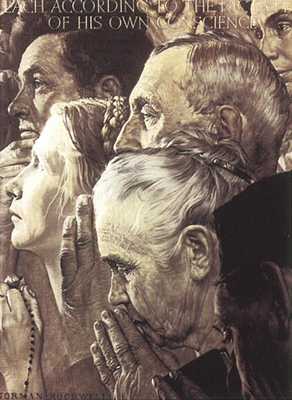 |
| Freedom to Worship |
“The third is Freedom from Want (at top of page) –which, translated into universal terms, means economic understandings which will secure to every nation a healthy peacetime life for its inhabitants-everywhere in the world.”“The fourth is Freedom from Fear –which, translated into world terms, means a world-wide reduction of armaments to such a point and in such a thorough fashion that no nation will be in a position to commit an act of physical aggression against any neighbor–anywhere in the world.”
 |
| Freedom from Fear |
“That is no vision of a distant millennium. It is a definite basis for a kind of world attainable in our own time and generation. That kind of world is the very antithesis of the so-called new order of tyranny which the dictators seek to create with the crash of a bomb.”
— Franklin Delano Roosevelt, Message to the Congress, 1.6.41
Eleanor Roosevelt made these tenets her personal quest, inspiring for United Nations Declaration of Human Rights in 1948 . Indeed, these Four Freedoms were explicitly incorporated into the preamble to the Universal Declaration of Human Rights which reads,
“Whereas disregard and contempt for human rights have resulted in barbarous acts which have outraged the conscience of mankind, and the advent of a world in which human beings shall enjoy freedom of speech and belief and freedom from fear and want has been proclaimed the highest aspiration of the common people…”
As we move into an election year preceded by nearly five years of war, tens of thousands of deaths (including thousands of US and “Allied” forces, those of who remember at least shadows of this earlier time will feel a sense of deja vu, a surreal knowledge that we haven’t gotten the message right yet, though many of us keep trying, using our ever dwindling Freedom of Speech to keep the blaze called Freedom burning, to keep the connection with our spiritual beliefs open and vibrant, to keep our table renewed with food, and to keep our families safe. The wisdom to share our bounty with those who do without.
The Four Freedoms speech inspired a set of four paintings by Norman Rockwell paintings published in The Saturday Evening Post on February 20, February 27, March 6 and March 13 of 1943, in the midst of World war II, a battle that was a unifying and identifiable force in America The paintings were accompanied by matching essays on the Four Freedoms. The US Treasury Department showcased the painting in a nationwide tour after their initial publication., raising some $130, million in war bond sales.
The original paintings now grace the new Norman Rockwell Museum in Stockbridge, Massachusetts, where hundreds of visitors each year may sit in awe at the elegant simplicity and human spirit evidenced in these works. While I had not thought too much of them, or not thought of them at all for a number of years, it seems especially appropriate at a time when we again have troops deployed, families alone and poverty on the rise that we revisit these ideals and work together to keep them not just alive but thriving.
Happy Thanksgiving
from the staff of
Clarksville Online
About Norman Rockwell
For more information on Norman Rockwell who’s art graces this article, visit the Official Norman Rockwell Web site, and that of the Norman Rockwell Museum.