

 My grandfather, William Curtis, knew daily hardships, privation and difficulty as a farmer in the Ozarks of Missouri, near Fort Leonard Wood. The community surrounding this army post came to be called little Korea by the soldiers training there and the residents of the Ozarks. Its bitter winters with regular severe storms of snow, ice, and below freezing temperatures, and summers with extreme humidity,earned that nickname.
Grandfather, lean, lanky, tall and bony, had muscles of steel from haying. plowing, chopping wood and milking cows daily. He worked diligently from sunrise to sunset. He had no electricity or indoor plumbing, and water for the household was carried in buckets from the spring at the bottom of the hill, up about 200 feet to the house. Though he had a good wife, Maggie, and eight children, he himself was constantly at work with farm chores, sometimes helped by hiring out a neighbor for 50 cents a day.
Grandfather’s medical care was given a low priority in his available resources. The farm produced only a meager income . For every ear of corn grown on his 40 acres, there were 10 rocks to be cleared. The land actually produced more useless rocks than corn. There was no such thing as “rock sou” in the Ozarks. The years of survival and stress took a toll on his health and at age 70 he was diagnosed with pneumonia; this disease without medication caused untold suffering and hardship. It caused the death of my grandfather, a man I respected and loved. For two years he took the role of father when I lived with them during the first two years of my life. In a way, I was his son and became his child as my single mother worked in a shoe factory in a town 25 miles away.
As the disease ravaged him, he moved to town to live with one of his sons, my Uncle Frank. The last time I saw him alive he was resting on a couch. His children did what they could to financially and morally support him. Grandfather was an honest moral, person.
Recently in my reading on the Civil War I was introduced to a new word: Atavistic, meaning the appearance of a physical attitude in a person that was found in an ancestor, relative or significant person.I believe that besides genetic traits, I carry a few of my grandfather’s characteristics. As I age I become more sensitive to his contribution to my life.
Within a year, grandmother packed her meager belongings and moved to town (Rolla, MO) He children assisted her in loading and unpacking the dozen quilts she made with scraps of brightly colored cloth The bought her a small house for $1,800, near her caring children. She made the diminutive place a sanctuary for her grandchildren. Unfortunately, she passed while I was attending seminary in 1961.
I remember my grandparents being cared for and provided for by their children. This is a situation many of us must confront: how to care for aging parents.
“Moving a parent into your home” is an illuminating article I read recently in Money Advisor (February 2008). This is one course of action open to an adult who parent totheir parent.
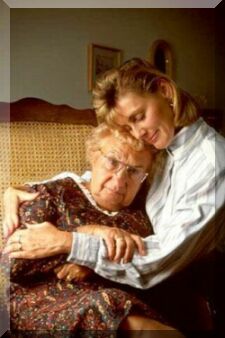 To make such a life changing decision, though, merits remembering what they have done for us. Our fond memories of how they kept us safe and protected, and sacrificed for us in our childhood will give us the motivation to care for them. Currently, this is a heated discussion. It’s time to give attention to caring for parents and assuring that their needs are met.
We are living in the sandwich generation. On this day, 34 million of our fellow citizens care for an aging parent of relative because of health problems and the devastation caused by mental downgrading. There are times when kit is practical to a share a home with parents. I praise my sister, Sharon, for unselfishly giving a home to my mother before her death in March.
What follows are suggestions on the subject of caring for a parent, especially if that parent is to move into your home. A comprehensive discussion of this subject is found in Money Advisor, 2.08, pg 10. A copy of this back issue is available for $5.00 from CRMA, 101 Truman Ave., Yonkers, NY 10703. This is one of my favorite periodicals.
Here are areas to research before bringing a parent into your home. Such decisions made out of affection and a sense of responsibility still require guidelines.
- Evaluate the situation legally to protect the parent’s legal rights and yours as well. Before the move, negotiate with siblings on expectations of what they’ll contribute monetarily and in personal time. It’s wise and worth the cost to have an official written document by an attorney of the commitment. Don’t settle for a verbal understanding or handshake for this agreement.
- Evaluate your situation financially. There are tax deductions when contributing to the support of a parent’s expenses. Also, remodeling to your home for a parent could be a tax deduction. It is critical, too, to research the options available for investing the parent’s assets. A financial adviser for a reasonable fee can suggest a conservative low risk portfolio.
- Evaluate the situation in terms of lifestyle. With certainty, your life will change when a parent moves in. The parent will have physical and psychological needs and may be dependent on you for transportation. The deserve privacy too. Make plans for their bedroom, television and bathroom. The room needs to be as spacious as possible. It make require remodeling, but it is worth the expense in the long run. Even the carpeting is to be analyze. Commercial grade carpeting is easier to clean and easier to maneuver with walkers and wheelchairs. Avoid scatter rugs and shag or heavily piled carpets. Berbers are a good choice.
- Evaluate the needed services. Changes in mental or physical health may require assistance that the family cannot provide. At some point it will be necessary to have a home care aide to assist a parent with bathing, dressing and other needs. My friend and a deacon of our church benefited from such an arrangement. Because of their low income, they received help through the state of Missouri. Adult day care can be a Godsend, reducing the number of hours of care the parent requires from family. Include the parent in entertaining activities and family events, and try to sustain active involvement in a church fellowship. Just as child care care blossomed through churches, and became an essential mission, perhaps the best care will be in a church day care program.
- Evaluate your personal needs. The addition of a parent to the family and home will perpetuate changes, influence lifestyle and impact emotions profoundly. An effective caregiver must preserve their own well-being before they can provide a healthy environment for a parent. Make time for yourself. Resume exercising, attend church and social activities, talk a walk with a friend, or have lunch or a cup of coffee out. It will rejuvenate you. Reserve time for your own family and include the parent in activities.
Caring for a parent in your home is a challenge. It has its benefits and its problems, but the problems can be minimized and worked through by the caregivers.Understanding the meaning of “tough love” is helpful when an adult child become the parent. The advice given for effective communication between a parent and child are applicable as well when you begin parenting your parents in later life.
As I reflect on this narrative, I am analyzing my own situation. At age 70, I recognize at least cognitively that my daughter may at some point be a caregiver for me. My children are spread out, and I hope I never have to make such a dramatic change. I am meditating on this possibility and have one option that is appealing to me: as the BoyScouts say, “Be prepared.”