

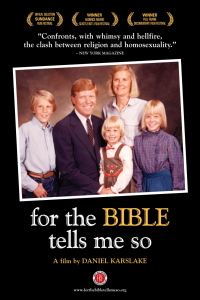
 My wife has a book that I have intended to read for years, but never found the time, “What the Bible REALLY says about Homosexuality.” Then I saw this movie available on Netflix, “For the Bible Tells me So” , and thought at this point in my life, I’m much more likely to get a quick movie in than to read a book.
The movie introduces you to several families that have two things in common 1) strong religious ties, and 2) a family member that is a homosexual. Director Daniel Karslake’s selection of families with different backgrounds is sure to connect with a variety of viewers. Theres a Midwest lawyer and stay at home mother that are Lutheran; a African American couple from North Carolina who are ministers in a AME church; there a Episcopalian elderly white couple from blue collar rural Kentucky (no spoiler here but their child was the first openly Gay bishop in the Anglican church, Gene Robinson); a single middle class mother, and a long time politician Dick Gephardt and his family.
[youtube]ajBR0dq0XXk[/youtube]
Karslake introduces each family through a historical lens, letting the viewer get comfortable and details the love stories of the parents, their marriage, child birth, and the eventual coming out of that child. The parents and family members frankness is refreshingly honest. We see the story of each family, their struggle, grief, and reconciliation; each in their own way but with all the different views it draws the audience into the families lives like your attending their Thanksgiving dinner.
 Intermingled between the life stories of these God fearing families, Karslake sprinkles in traditional Biblical arguments, from Leviticus to Romans, regarding homosexuality. Historians, Pastors, Theologians, family members, and others (including clips from news reels and tele-evangelists) all give their interpretation of the Bible.
Later, the movie analyzes how the Bible is often used to demonize and condemn homosexual behavior. It takes those Biblical passages that are typically quoted to say that God thinks its an abomination, and puts them into the context of the time they were written, to offer a different opinion.
The film reveals how religious families react to their child coming out of the closet. We see their fears, confusion, struggles, and how they focus that energy. We see the difference between having supportive parents versus unsupportive. When the director asked Christians what the Bible says about homosexuality, that they didn’tt know what the Bible says but only what they’ve been told.
I thought the movie was good, and at just over 90 minutes was just long enough. The access to the families is intimate and compelling. The historical references to the Bible were informative. For those who are well read, there probably isn’t anything new here. The power in the film lies with the families’ individual stories that really draws the viewer into their story with a fresh perspective.
I encourage you to check out the film and make your own decision.
About the Movie
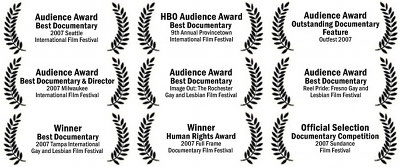
Can the love between two people ever be an abomination? Is the chasm separating homosexuals and Christianity too wide to cross? How can the Bible be used to justify hate? These are the questions at the heart of Daniel Karslake’s FOR THE BIBLE TELLS ME SO. A World Premiere in competition at the 2007 Sundance Film Festival, FOR THE BIBLE TELLS ME SO was also honored with Audience Awards at the 2007 Seattle and Provincetown International Film Festivals and The Kathleen Bryan Edwards Award for Human Rights at the 2007 Full Frame Documentary Film Festival. This provocative, entertaining film concisely reconciles homosexuality and a literal interpretation of Biblical scripture.
Through the experiences of five very normal, very Christian, very American families — including those of former House Majority Leader Richard Gephardt and Episcopal Bishop Gene Robinson — we discover how people of faith handle, or sometimes tragically fail to handle, having a gay child. Informed by such respected voices as Bishop Desmond Tutu, Harvard’s Peter Gomes, Orthodox Rabbi Steve Greenberg and Reverend Jimmy Creech, FOR THE BIBLE TELLS ME SO offers healing, clarity and understanding to anyone caught in the crosshairs of scripture and sexual identity.
Some of what we hear from the Theologians
Reverend Dr. Laurence Keene, Disciples of Christ:
“When people ask questions about homosexuality, almost always they follow with, ‘and what does the Bible really say about it?’”
“When the term ‘abomination’ is used in the Hebrew Bible, it is always used to address a ritual wrong – it never is used to refer to something innately immoral. Eating pork was not innately immoral for a Jew, but it was an abomination because it was a violation of a ritual requirement.”
“I have a soft spot in my heart for literalists because I used to be one. However, when someone says to me ‘this is what the Bible says,’ my response to them is, ‘No, that’s what the Bible reads.’ It is the struggle to understand context and language and culture and customs that helps us to understand the reading, or what it is saying.”
“There’s nothing wrong with a fifth grade understanding of God, as long as you’re in the fifth grade.”
“There is no ability to procreate when you engage in homosexual behavior, so it was a violation of a cultural norm. [This was] the sin of Onan in the Old Testament, where Onan is sentenced to death because he ejaculates out of the woman’s body, so his partner doesn’t get pregnant. As the King James Version says, ‘Onan spills his seed upon the ground, and God strikes him dead.’ It was ritually impure. It was an abomination.”
Reverend Peter Gomes, Harvard:
“There are about 6 or 7 verses in all of Scripture that speak to even remotely what we might call homosexual activity or homosexual conduct.”
“[Literalists] are failing to read the Bible within the context of its authors and of its original culture.”
Reverend Steven Kindle, Clergy United:
“In this particular one, it’s Leviticus Chapter 20, Verse 13, it says if a man lies with a male as with a woman, both of them have committed an abomination, they shall be put to death, their blood is upon them – if you read the Bible on a face value level, that reading disregards several very important things: the first one is just a few verses before that Moses teaches in Leviticus that it is an abomination to eat shrimp….It is an abomination to eat a rabbit.”
Rabbi Brian Zachary Mayer:
“A few verses above and below it says you shouldn’t plant two different seeds in the same hole, you shouldn’t commingle your crops… There is other text that says you shouldn’t wear linen and wool together. To just pick out, this is the one that we’re going to follow…the Bible doesn’t come that way – it’s selective reading…Those Biblical laws, they’re known as the Holiness Code. They were laws that were supposed to help people at that time find holiness in their lives.”
Reverend Susan Sparks, American Baptist Church:
“To me that’s the important thing to recognize: the historical context in which this was written. That particular section on a man not lying with a man goes to procreation. It is about a nation trying to grow. At the time, the Hebrew people understood that male seed was actually all of nascent life contained right there – women had nothing to do with actually the birth except for just incubation, so that particular section was about saving seed, saving seed only to procreate so the nation could grow.”
Revered Mel White, Soulforce:
“When I was on Larry King Live, somebody called in and said, ‘What do you guys do in bed?’ Larry hung up on him and said, ‘that’s none of your business.’ And I said, ‘We’ve been together in the same bed for 24 years – we’re like everybody else, we sleep in bed. And King said: ‘Once they find out you’re as boring as we are, it’s all over.’”
“Now it (the Bible) is being used, misused, to condemn gay people – it’s an old trick. Fundamentalist Christians have been using it throughout the ages, and now they’re doing it again.”
Archbishop Desmond Tutu, Nobel Peace Prize Laureate:
“The Bible is the word if God through the word of human beings, speaking in the idiom of their time, and the richness of the Bible comes from the fact that we don’t take it as literally so that it was dictated by God.”
Some of what we hear from the families
The Gephardt Family
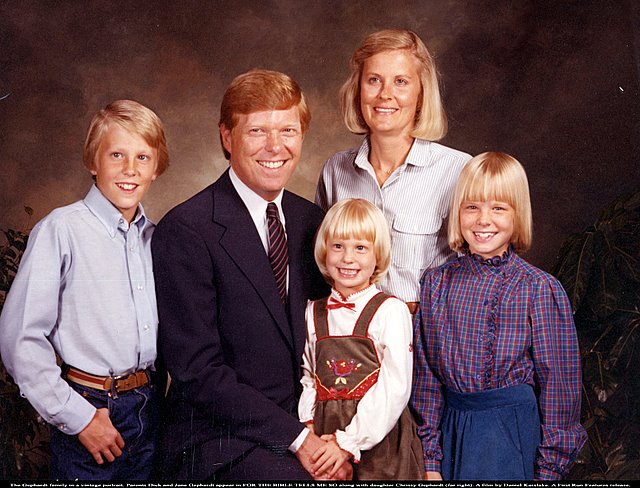
Chrissy Gephardt: “Growing up in the Catholic Church, it was never something that I heard explicitly, but I definitely knew that that was part of the Bible and in fact, there were two things that I remember were an abomination: homosexuality and suicide. And I’ll never forget thinking that ‘Oh my gosh, you can never commit suicide because you’re going to go to hell and you can never be gay because you’re going to go to hell.’”
Dick Gephardt: We thought she was…
Jane Gephardt: She was always a jock.
Dick Gephardt: She was athletic
Jane Gephardt: She was good, too. She was a good athlete.
Dick Gephardt: She was a good athlete – she also wore pants more than skirts and dresses
Jane Gephardt: But that was because she was trying to be like Matt, like her older brother
Dick Gephardt: We thought that, but…
Jane Gephardt: Well that’s what we thought, and I still think that…
The Robinson Family
Isabella “Boo” McDaniel (Bishop Gene Robinson’s ex-wife): “I was just glad to be there for the consecration, because I thought by my presence I could really show that I was supportive. I mean, there was just huge security, Gene had a bullet proof vest under his vestments and I realized how scary it must have been for him.”
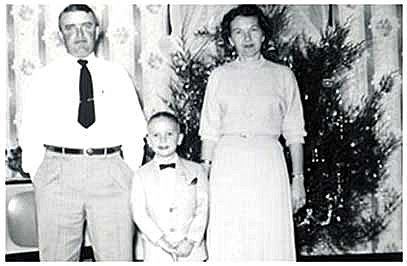
Bishop Gene Robinson: “My parents are probably the two best Christians I know and they don’t do it because they ought to do it, they just do it because it’s who they are. So to have them presenting this [the consecration vestments] to me – it’s just kind of a coming out for them as well. They’re all of a sudden just completely light hearted and relieved about this and are able to be proud.”
The Reitan Family
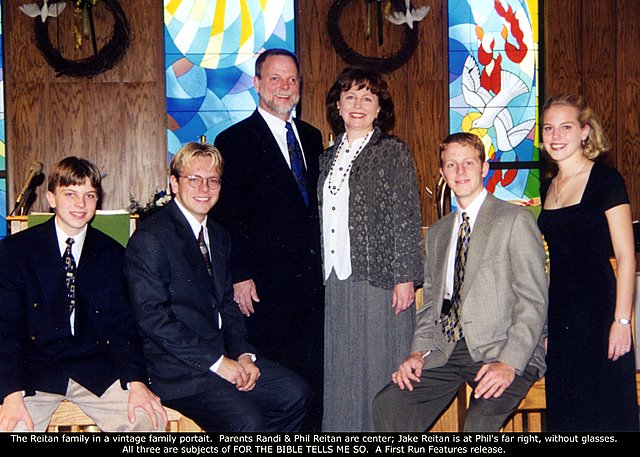
Jake Reitan, activist: “I remember very distinctly when I was a kid when I first learned that so much of the world wasn’t Christian – and that just kind of blew my mind – because I was of the perspective that everyone is Christian because everyone wanted to go to Heaven, you know, and then I learned that only one third of the world was Christian and I thought to myself: are that many people going to Hell?”
“I remember one Sunday where my pastor preached on homosexuality and it wasn’t in the best of light, but I didn’t want to question because I knew that the answers wouldn’t be good.”
The Poteat Family
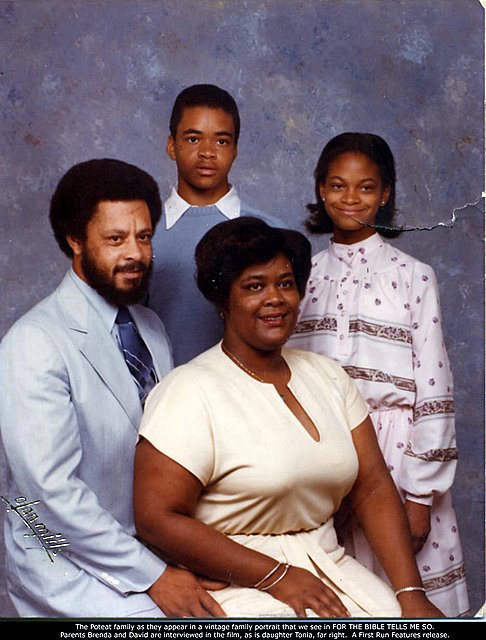
David Poteat: “I had good kids. We had one of each sex – when my kids were growing up, I said ‘God, please don’t let my son grow up to be a faggot and my daughter a slut.’ And he did not. He did not do that. He reversed it.”
Brenda Poteat: “I can’t say where in the scheme of things that I saw this talk show [the Phil Donahue show] and I realized that what I was embarrassed about was that I was thinking totally of how she was having sex and not about her as a person. When I saw the talk show with two guys — buff, good looking guys — and they were asked the question ‘which one of you guys takes on the female role in the relationship’ and they said ‘neither one of us, we are attracted to men, if we were attracted to women, we’d be with women.’
“I’m sitting there thinking, but what about the ones that twist their butts and act like women, what are they attracted to? Who are they? And I’m thinking ‘but that’s all you’ve ever seen.’ That’s what comes to mind when you hear ‘homosexual’: you think of the girlfriend-acting fellow, the butch dykey-acting woman. You don’t think about everyday people, and there are ‘everyday people’ who are gay, and you’re thinking about how they’re having sex.
“I had to realize that she was my daughter: she had the same personality, she enjoyed the same things that she did before I knew she was gay. Then I had to stop thinking about Tonia that way. Although I still do not approve of the lifestyle, it was a big burden off me, that I could relate to her better and I stopped trying to push her.”
Awards
For more information
Visit the official movie web site at http://www.forthebibletellsmeso.org/
About First Run Features
First Run Features was founded in 1979 by a group of filmmakers to advance the distribution of independent film. Under the leadership of the late independent film pioneer, Fran Spielman, First Run Features quickly gained a reputation for its controversial catalog of daring independent fiction and non-fiction films. Today First Run remains one of the largest independent theatrical and home video distributors in the United States; its legacy includes films by such notable directors as Spike Lee, Michael Apted, Jane Campion, Ross McElwee, Michael Winterbottom, Sven Nykvist, Peter Jackson, Dariush Mehrjui, David O. Russell, Lizzie Borden, Claude Chabrol, Jan Svankmajer, Peter Watkins, Radley Metzger, Victor Nunez, the Quay Brothers, Kim Ki-Duk and Satyajit Ray.
For more information, or to browse their many other films, visit their web site at: http://www.firstrunfeatures.com/



You know what I find outrageous about this article. It does not not present true Biblical Scholarship and further the article only included the opinions of those who agree with the same misguided opinion.
2nd ALL SEXUALITY OUTSIDE OF MARRIAGE IS WRONG. You dont have to look very far to see that in the Scriptures. Further the book of Romans makes it very clear that laying with a man as a man or laying with a woman as a woman is wrong. Further a look into the culture of the Corinthians to see that they were a culture that accepted homosexuality and yet Paul says that those who practice homosexuality will not inherit the Kingdom of God.
Well, I would first like to say that the Bible should NEVER be used to justify hating ANYONE! I do agree that the Church at large has treated those who are homosexual or lesbians less than Godly. I believe that a person regardless of their moral stance should be treated with respect, honor, and love.
That being said as we can see from the current news, for me to get up in my church on Sunday morning and saying that the Bible says Homosexuality is a sin is close to being made a hate crime. What about adultery or sex outside marriage? The Bible equally condemns both of those particular cases of sexual immorality.
The problem to me seems that many people find it hard to separate the sin from the person, but do not be deceived the Bible very clearly condemns homosexual/lesbian relationships (not the people) as strongly as heterosexual relationships outside of marriage.
Sin is sin regardless of what context it is in.
There are two passages that specifically use the word homosexual that have nothing to do with Temple prostitution, abuse of children, or any of the other myriad of excuses that the activist use to justify themselves. I think it is worthwhile to look at them.
1 Tim 1:8-11 “But we know that the Law is good, if one uses it lawfully, realizing the fact that law is not made for a righteous person, but for those who are lawless and rebellious, for the ungodly and sinners, for the unholy and profane, for those who kill their fathers or mothers, for murderers and immoral men and homosexuals and kidnappers and liars and perjurers, and whatever else is contrary to sound teaching, according to the glorious gospel of the blessed God, with which I have been entrusted.”
1 Cor 6:9-11 “Or do you not know that the unrighteous will not inherit the kingdom of God? Do not be deceived; neither fornicators, nor idolaters, nor adulterers, nor effeminate, nor homosexuals, nor thieves, nor the covetous, nor drunkards, nor revilers, nor swindlers, will inherit the kingdom of God. Such were some of you; but you were washed, but you were sanctified, but you were justified in the name of the Lord Jesus Christ and in the Spirit of our God.”
There are other passages that are fairly clear but are from another day.
I know David Shelton very well. I love him as a Brother in Jesus Christ. I believe he is a believer in Jesus Christ. I also believe he has believed a lie, but nonetheless I love him and can talk with him and hold civil conversation even in the midst of disagreement. I think the entire CHURCH could learn from our relationship.