

NAACP charges Tennessee Code and Civil Rights violations in Clarksville’s proposed redevelopment ordinance.
 Jimmy Garland Sr., president of the Clarksville Chapter of the NAACP, has contacted the Justice Department in Washington, D.C., and the HUD (Housing and Urban Development) office in Nashville, charging that the controversial Clarksville Downtown Redevelopment and Urban Renewal Plan does not adhere to Tennessee Codes and will have a detrimental effect on “mostly the poor, elderly and minorities residents of this inner city community.” The plan has been highly touted by city officials, Mayor Johnny Piper, and the Downtown Business Partnership (DDP).
Garland further charges that the plan is a possible “civil rights infraction” by the Clarksville City Council. The Council is scheduled to hold a second reading and a final vote on the ordinance Thursday evening during a special session scheduled for 7:30 p.m. in City Council Chambers at 108 Public Square.
“No real plan has been introduced that will define the actual areas to be redeveloped and which properties are actually blighted within the targeted area,” Garland said.

Clarksville NAACP President Jimmie Garland Sr. [center] stands with irate property owners outside a “public” hearing on the “blight” bill.
In an April 24 letter to HUD Field Office Director William H. Dirl, Garland wrote:
“The plan is supposed to be based upon section 13-20-203 of the Tennessee Code Annotated (TCA), but the template outlined in the TCA documents is not being followed. The Mayor of Clarksville and the city council have cherry picked through the code, and are on schedule to implement a blatant racist policy that has a detrimental affect on “mostly the poor, elderly and minorities residents of this inner city community.’ The language in the TCA clearly states, “A plan must be in place prior to any redevelopment plan being adopted”.
According to Garland, the city’s legislative branch of government has adopted an ordinance and a map of our inner city, “with no clear plan.” He cites Section 13-20-203 (1) (A) (i), (ii), (iii) of TCA, which clearly states the redevelopment plan must:
(i) Indicate its relationship to definite local objectives as to appropriate land uses and improved traffic, public transportation, public utilities, recreational and community facilities and other public improvements;
(ii) Indicate proposed land uses and building requirements in the area; and
(iii) Indicate the method of the temporary relocation of persons living in such areas, and also the method of providing (unless already available) decent, safe and sanitary dwellings substantially equal in number to the number of substandard dwellings to be cleared from the area, at rents within the financial reach of the income groups displaced from such substandard dwellings.
Last Saturday, the Clarksville Property Rights Coalition ran a 1/2 page advertisement in the Leaf Chronicle re-iterating their opposition to this plan, which would impact 1800 homes and small businesses across the two-square mile area which has been dubbed “Blightsville” based on the potential for blight designations and property takings under an “assemblage” clause in the ordinance.
The ad was initially rejected by the Chronicle, which charged that it contained errors in fact. After legal wrangling and persistence by the CPRC, the ad, which was supposed to run in the news section, appeared buried in the last few pages of the Saturday paper in much the same way city officials apparently want to bury opposition to this ordinance.
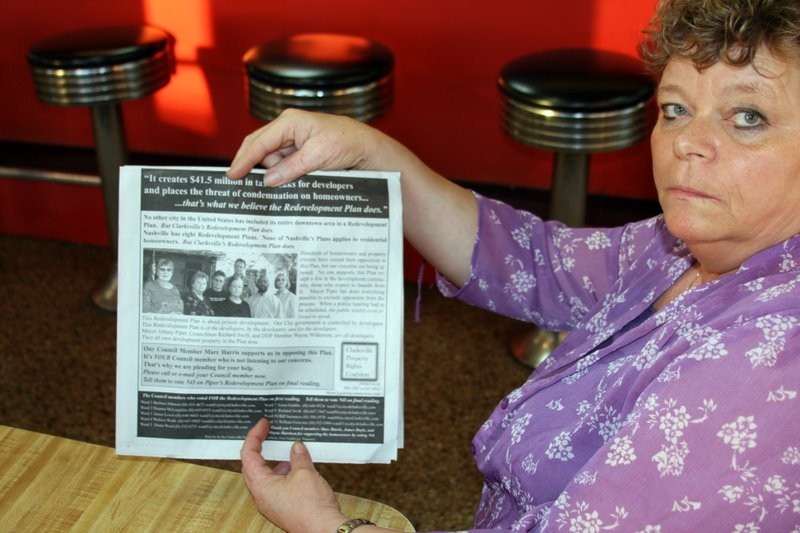
Joyce Vanderbilt, owner of Kelly’s on Riverside Drive, with the CPRC ad
John Summers, counsel for the CPRC, wrote the following to the Chronicle:
“I specifically asked for placement in a news section, preferably the front section. You stated it would be on page 4. I conveyed that information to my client. There was not reason for me to have convey that information to my client … I was given that information. And I understand that placement is in the discretion of the newspaper. I have never had a newspaper interject itself in the composition of a political advertisement before, nor have I ever had a publisher involved in determining an advertisement’s content. I understand better now the reputation of the Leaf-Chronicle has earned among its residents.”
Leaf Chronicle publisher Gene Washer is a member of the DDP, the business development organization spearheading the redevelopment action.
Possible civil rights infraction by city council, Clarksville, TN
In presenting his case, Garland states:
“The NAACP is very concerned about the possibility that many of our elderly citizens, who subsist on a fixed income, may fall victim to a flawed ordinance created to help advance inner-city growth and upgrade of properties located in the areas targeted to be redeveloped. Our concerns are further enraged because many of the elderly will not be financially stable to comply with the standards the are to be used to allow them to remain in homes they acquired over their lifetime. Lastly, we are concerned because the areas targeted to be redeveloped under this ordinance is predominantly comprised of minority (black) residents who make up the only Majority-Minority council Ward (53%) within the city. According to the voting manual of the state of Tennessee, the city or county can not take any action that would cause a Majority-Minority Ward to be dissolved unless the leaders of the municipalities are willing to create a similar ward in another area of the voting district.”
Garland included letters from residents of the targeted areas that address the concerns of the citizens who are being affected by the proposed ordinance. Many meetings have been held, and letters written to local city council members, expressing the objections to the ordinance as written and compelling the council to repeal the current ordinance and start anew, ensuring the public is allowed to be active participants in the development thereof. He noted that there has been “no positive response from anyone associated with our local governing body except for Councilmen Marc Harris, Jim Doyle, and Wayne Harrison. The remaining members of the council have resolved to ignore the will of the residents of the affected area.”

Hundreds of property owners queue up to sign petitions against the redevelopment ordinance at a standing room only December 2007 grassroots meeting at the L&N Train Station
Garland writes further:
“None of these actions has been done; there is simply no redevelopment plan nor is there an urban renewal plan. The redevelopment plan is simply an attempt by the local legislative body to wipe out low to moderate-income neighborhoods through the Housing Authority’s power to eliminate blight. As written, the language within the redevelopment plan is egregious and the effects on the mental and social demeanor of the elderly residents of the affected communities, Red River District, Emerald Hill and Brandon Hill communities are most traumatic.
“The Clarksville Branch of the NAACP is seeking your assistance in ensuring the Tennessee Code Annotated section 13-20-203 and 13-20-211 will be used as intended, not as a tool for racism. Local citizens are very concerned that the local authority has the power to condemn their properties and release them to local developers. The cause of their concerns is evident throughout the recent Redevelopment Plan and Urban Renewal Plan presented to the citizens during a town-hall meeting on March 21, 2008.
“As president to the Clarksville Branch of the NAACP #5582, I am requesting that a representative from your Department of HUD, be dispatched to evaluate the effect this redevelopment plan will have on the livelihoods of the members of the communities targeted for redevelopment in Clarksville, TN, in particular, residents residing in the Red River District, Emerald Hill, New Providence area and Brandon Hill communities. Many of the citizens of these communities are not in a position to challenge the local leadership because of lack of knowledge, and failure of the local leadership to allow competent representatives to speak out on their behalf when and where it matters.”
Garland included a of attachments to the letter and asked for an expedited review of the request and the documents in response to “the dire situation here in Clarksville” Garland requested on site visits to the areas and residents that will be affected upon implementation of this redevelopment ordinance.
“The sanctity of the elderly population of the majority-minority community rests in your hands.” – Jimmie Garland Sr.
 Garland forward copies of the letters and documents to the NAACP Tennesse State Conference and National Headquarters Civil Rights Division, The Department of Justice in Washington D.C., the State Attorney General’s Office in nashville, and General Counsel for the NAACP in Baltimore, Maryland.
In his supporting dicumentation, Garland cited a report, Victimizing the Vulnerable, by Dick M. Carpenter II, Ph.D. and John K. Ross of the Institute for Justice [06.07], which reads:
“As the numbers in the table indicate, the predictions of Justices O’Connor and Thomas held true: Losses from eminent domain abuse “fall disproportionately on the poor,” and particularly on minorities.35 Eminent domain project areas include a significantly greater percentage of minority residents (58%) compared to their surrounding communities (45%). Median incomes in project areas are significantly less ($18,935.71) than the surrounding communities ($23,113.46), and a significantly greater percentage of those in project areas (25%) live at or below poverty levels compared to surrounding cities (16%).”
From Garland’s Letters:
Background:
An organization, called the Downtown District Partnership (DDP) was established in 1999 to help revitalize the intra-city of Clarksville, Tennessee. Their mission was to ensure the uniformity of the reconstruction of our town following a disastrous tornado that hit our inner city in January of 1999. Since its inception, ordinances have been created to specify how signs are tobe displayed, where trees must be planted within an area, as well as other deliberate controls. In September of 2007, members of the Clarksville, TN city council approved an ordinance that allows the DDP, in concert with other arms of the local legislative body, to declare areas within the City limits of Clarksville to be blighted properties. (See App 02) The document authorizes the city council to take ownership of properties using the eminent domain clause and turn the property over to private contractors to make improvement under a tax incentive finance provisions umbrella.
During the past several weeks/months, residents of the affected communities have been very vocal in their opposition concerning the proposed ordinance. They cited the lack of proper notification of the pending ordinance, timing of the ordinance implementation, and the fact that their homes being part of the historic district does not garner their properties to be designated areas of blight. Residents residing in the historic district have acquired an attorney to assist them in their attempt to have the ordinance repealed. (See letters at APP 26).

Angry residents face off against the City Council (02/08)
The city council along with the DDP planned and hosted a meeting to receive input from residents of the areas designated as blighted. The public forum was held on March 21, 2008 at the Burt Elementary School located adjacent to the Austin Peay State University Campus, Clarksville, Tennessee. The purpose of the forum was to try to quell the concerns that currently exist throughout those communities, i.e. Red River District, Brandon Hill, Emerald Hill, and the downtown business and other properties., as they relate to the ordinance. The meeting was held in the cafeteria of the school, which limited the participation of not only residents of the targeted area, but inhibited the participation of concerned citizens from outside the district. (See App 27, Remarks by City Councilman Jim Doyle, and Marc Harris,).
The group of concerned citizens asked that their legal representative be allowed to speak on their behalf. Their attorney, Attorney John Summers, submitted the request to Mayor Johnny Piper on March 19, 2008. There was a prompt reply from the mayor’s office stating that no one would be allowed to speak at the public forum but concerned citizens were invited to submit written comments for council’s consideration.
Branch Concerns:
The local branch of the National Association for the Advancement of Colored People (NAACP) major concern is that Ward 6 is the only majority-minority ward that exist in the city of Clarksville, Tennessee. During our last census cycle, year 2000, we attempted to have an additional city ward designated as a majority minority ward but failed. Our requests failed because the lone minority representative serving on the city council voted against our requests for the declaration.
The current ordinance, as written, leaves very little speculation on what the outcome of the redevelopment of the areas targeted to be redeveloped would be if the ordinance were implemented as written. Several paragraphs throughout the document outline scenarios where properties do not have to be in a substandard state to be seize under the umbrella of eminent domain to complete a project. That is the most detrimental part of the ordinance. It leaves citizens without any real sense of protection concerning the status of their property, plighted or not, once developers express an interest in redeveloping the areas. The ordinance does not take into account the fact that many of the residents living in the targeted redevelopment areas are elderly minority residents, who are living on fixed incomes. If their properties are identified as unsuitable, they would not have the funds to make the necessary corrections. Therefore; establishing a policy and implementing the same to require them to return and/or maintain their properties to standards that are yet to be defined by the DDP, would be detrimental to their welfare and place an unethical burden on their meager means of survival.
Residential Concern:
In an article entitled, “Victimizing the Vulnerable”, prepared by Dick M. Carpenter II, Ph.D., and John K. Ross, of the Institute for Justice ,June 2007, it has been substantiated that, “trend among urban redevelopment strategies is to attract wealthier middle classes back to the inner city, typically resulting in the replacement of one population with another. Much of the research focuses on urban renewal, which generally refers to the set of redevelopment policies and projects used during the 1950s and 1960s to make room for downtown commercial development activities, more upscale residents, or both, by leveling “blighted” neighborhoods and displacing existing populations from central-city areas. Demographically, these displaced populations were disproportionately ethnic or minority Communities and/or low-income.”
Several residents of the affected areas have stopped me and inquired about the proposed plan. To date, my response has been that the document does not appear to be written to protect the owners of properties. Neither is its intent to assist residents in returning their properties to standards to be determined by appointed members of the board that has been created to monitor the areas targeted for redevelopment.
Coupled with the fact that the piece of legislation framed by the DDP and presented to the council for approval, a map distributed at a meeting held at Burt Elementary school during the month of August 2007, clearly shows APSU does have an interest in acquiring the properties in question. The fact that the ordinance declares all properties in the vicinity, with the exception of properties owned by APSU, as blighted also make the purpose of the ordinance suspect. (See App 06) In speaking with a resident from the Red River District, Reverend George Forte, “APSU acquired 75% of that community to complete it last campus redesign”. The belief of some of the residents of the Red River District is that they are now coming back to acquire the remaining 25%.
If this ordinance is permitted to remain in place, and if developers realize the sweetheart deal they are getting for investing in this area, it would gravely dilute the voting strength of the only majority-minority district within the city of Clarksville, TN. Regardless of whether or not the citizens vote, they will at that point not be able to elect candidates of their choice to represent the minority citizens of that ward. If the citizens vote, they will at that point not be able to elect candidates of their choice to represent the minority citizens of that ward.
Bottomline:
As president to the Clarksville Branch of the NAACP #5582, I am requesting that a representative from the Department of Justice be dispatched to evaluate the effect this redevelopment plan will have on the livelihoods of the members of the community targeted for redevelopment (Red River District, New Providence area and Brandon Hill communities. Many of the citizens are not in a position to challenge the local leadership because of lack of knowledge, and failure of the local leadership to allow competent representatives to speak out ontheir behalf when and where it matters. I have several attachments related to the information contained in this document that could be used as reference data. I am more than willing to send this resource disk to you for your information. Request your review of this document be expedited and we hope your response to the dire situation here in Clarksville TN includes an onsite visit of the areas and residents that will be affected upon its implementation. The sanctity of our elderly population of the majority- minority community rests in your hands.
Enclosed:
Copy of St & Gen Election Ward 6 ‘94
Copy of St & Gen Election Ward 6 ‘98
Copy of St & Gen Election Ward 6 ‘02
Copy of St & Gen Election Ward 6 ‘06
Resident Letter, Martha Hendricks
Resident Letter, Patricia Sharpe
Resident Letter, Walter & Cindy Marczak
Resident Letter, Lynne Garite
Resident Letter, Debbie Hunter
Resident Letter, Joyce V.
A Study Victimizing the Vulnerable, Dick M. Carpenter II, Ph.D., John K. Ross,
Institute for Justice ,June 2007
Additional Enclosures listed below are available at (the agencies contacted) request:
Resource Disc
App 01 Cover letter
App 02 Community Dev Changes Redev Plan 04-08
App 03 Clarksville TN Land Use Master Plan
App 04 LC article, on forum, 20 Mar 08
App 05 Clarksville Center Redev Plan
App 06 Austin Peay State University Master Plan
App 07 Austin Peay State University Maser plan Composite
App 08 Eminent Domain in TN ‘92
App 09 Eminent Domain, what is and how will it be applied
App 10 MTAS Advisory-CCRP
App 12 Montgomery County Voting Precincts
App 13 CCRP Letter
App 14 CCRP Letter 2, Final
App 15 LC_Mayor’s Game Plan article
App 16 Public Hearing Postcard
App 17 LC Ad, Block Grant Workshop
App 18 KCDC fieldtrip report-Rev.
App 19 Clarksville Redev Final Plan 04-08
App 20 Ordinance 73-2005-06
App 21 Timeline for Clarksville Center Redev Plan
App 22 Redev Area Districts 2006
App 23 Frequently Asked Questions_ District Ordinance
App 24 Clarksville City Wards
App 25 TN Redistricting Manual, 2000
App 26 Letters for residents of Emerald Hill
App 27 DVD, Public Hearing, 040508



I commend the action taken by the Clarksville Branch NAACP in this matter. The local government has shown itself resentful and resistant of the public concern and outcry against the redevelopment plan and ordinance. They have displayed a persistent blindness to their own disregard of the state’s requirements for such redevelopment actions.
Perhaps the involvement of federal gov’t assets will bring a calmer analysis of the city’s plan. The violation of state’s own voting rights protections should give pause to these federal assets. HUD’s involvement would seem to mandate that its own guidance for its programs are reviewed with a scrutiny that has apparently escaped our local officials thus far.
As noted in the NAACP’s complaint, protections mandated by the state have been specifically omitted from the Clarksville structure. These omissions can not be explained away with the wave of a hand.
Please get a copy of Steven Greenhut’s book, Abuse of Power. Ask your library to have a copy available as well. It will tell you all you need to know about the property rights abuse caused by bogus blight and developer driven redevelopment areas.