

 When I read of the death of legendary designer Yves Saint Laurent at the age of 71, I felt a generation of masterful design slipping away. He was among the last on a list of greats that include Coco Chanel, Givenchy, Pierre Cardin, Nina Ricci, Valentino, Oscar de la Renta, Balenciaga and Christian Dior.
That hallowed group spearheaded an era of glamour evidenced in romantic and elegant couture, offered unparalleled, unequaled garments that now grace fashion institutes and museums. [At left, First Tuxedo: 1966 Fall/Winter Collection No 76, Nap and satin silk jacket and trousers, madarin Tuxedo shirt. Tie, Cumberbund and satin silk ankle boots, metal cufflinks with fancy pearls. Foundation Pierre Berge — Yves Saint Laurent, Photo Foundation Foundation Pierre Berge — Yves Saint Laurent]
The creations of these master craftsmen of fashion were emulated, a source of inspiration to ensuing generations of fashion designers. They were trendsetters too, shaping fashion to match the shape-shifting of global cultures. Nowhere was that more evident than in Saint Laurent’s transformation of the pantsuit for the world of working women. His adaptation and softening of the suits men wear to fit the emerging world of women in business was groundbreaking, changing the face of fashion in the workplace.
Actress Katherine Hepburn years earlier broke through boundaries with her confident stylish wearing of women’s trousers in the 30s, but it wasn’t until Yves Saint Laurent introduce pantsuits for the professional women in the 70s that the change took hold.
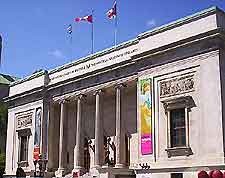 It is ironic that Saint Laurent passed away just as a spectacular retrospective of his work opens at the Montreal Museum of Fine Arts (at right). I scanned the web for photos of his work, culled them for my private web album of fashion, though the photos for this story were submitted by the MMFA. My kind of fashion. The Montreal exhibit will be presented from May 29 to September 28.
Curators working in collaboration with the Fine Arts Museums of San Francisco have designed and developed, in partnership with the Fondation Pierre Bergé – Yves Saint Laurent, the first retrospective spanning the forty years of creation of the Maison de haute couture Yves Saint Laurent. From Montreal, the exhibit will move to the de Young Museum of San Francisco, from November 1, 2008, to March 1, 2009.
I read about this and thought, well, I am going to be just a few hours and a border crossing from this exhibit in another month. Wow! I see an alteration in itinerary on my agenda. One rooted in some 40 years of my adoration for this designer and his peers.
 Though it was 60s, the age of the mini-skirt, the maxi-dress and Mary Quant, as a teenager with a bent for sewing and design, I poured through magazines seeking out the newest cut and drape of Europe’s high fashion season, waiting, holding my breath, for the patterns to emerge in Vogue or in the pattern books at my local fabric outlets. The shape of a collar, the length of a sleeve, the swirl of a skirt, the meticulous matching of a fabric’s weave and color. I drank it up. made my own copies, sought unconventional fabrics that “would work.”
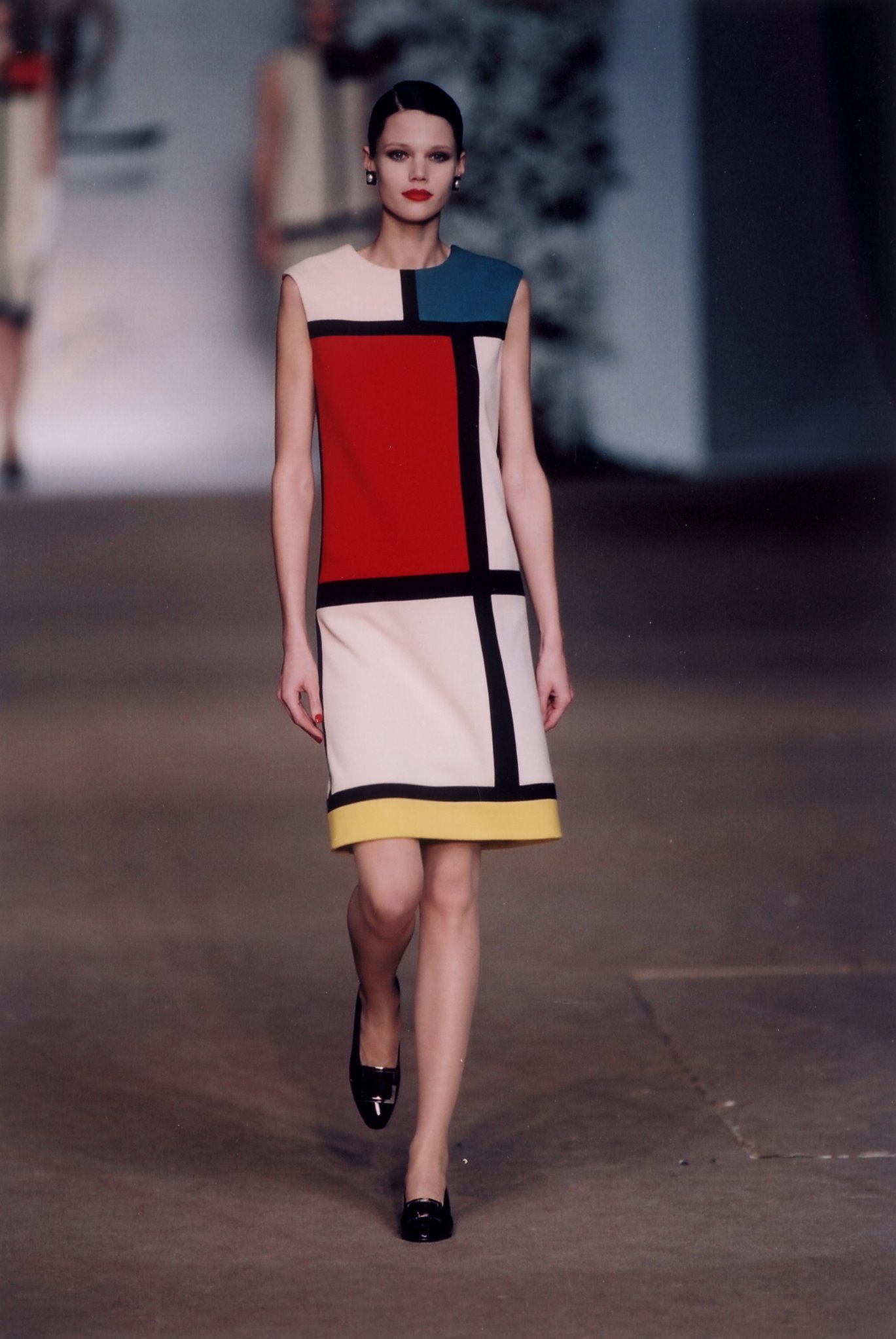
[At left: Cocktail Dress, Homage to Mondrain, 1965 Fall/Winter Collection No. 81; Wool Jersey yoke. faceted jet stud earrings with fancy pearls, patent leather pumps with metal buckles. Foundation Pierre Berge — Yves Saint Laurent, Photo Foundation Foundation Pierre Berge — Yves Saint Laurent]
As a teenager, my closet held Catholic school uniforms, work clothes, fishing boots, neat suits with accessorized hats and gloves, and ball gown and dresses for a professional ballroom dancing obsession that began at age 14. Back when you still find a dance orchestra and slick new dance floor on every corner. I didn’t buy my first pair of jeans until age 30 had come and gone, somewhere in the 80s.
I lived in a river town with fabric mills and outlets at every turn; I knew just where to get the best fabrics at the best prices. For while, I worked at a fabric mill outlet, selling fabrics by the yard, learning the nuance of weave, texture, grain, color shading, dye lots…
My friends and I scanned the European press and all the fashion magazines for hints of what was to come our way, working on the principal that what appeared in Europe this year would hit Canada next year and make it to the USA a year or two after that — it was the pre-internet age. I went to the movies to be entetained and ended up copying Givenchy’s designs for Audrey Hepburn in How to Steal a Million and Breakfast at Tiffany’s (where my passion for the “little black dress” was born), Channel’s neat little suits, Balenciaga gowns, and, of course, St. Laurent’s everything. At least, I tried. And it helped that in those days that at 5’9″ I weighed a mere 100 pounds soaking wet. A clothes-horse with an appetite like … let’s not go there. I was skinny. Hepburn slender. Twiggy thin.

Exhibition Yves Saint Laurent — May 29-September 28, 2008, Montreal Museum of Fine Arts. Photo: Denis Bernier
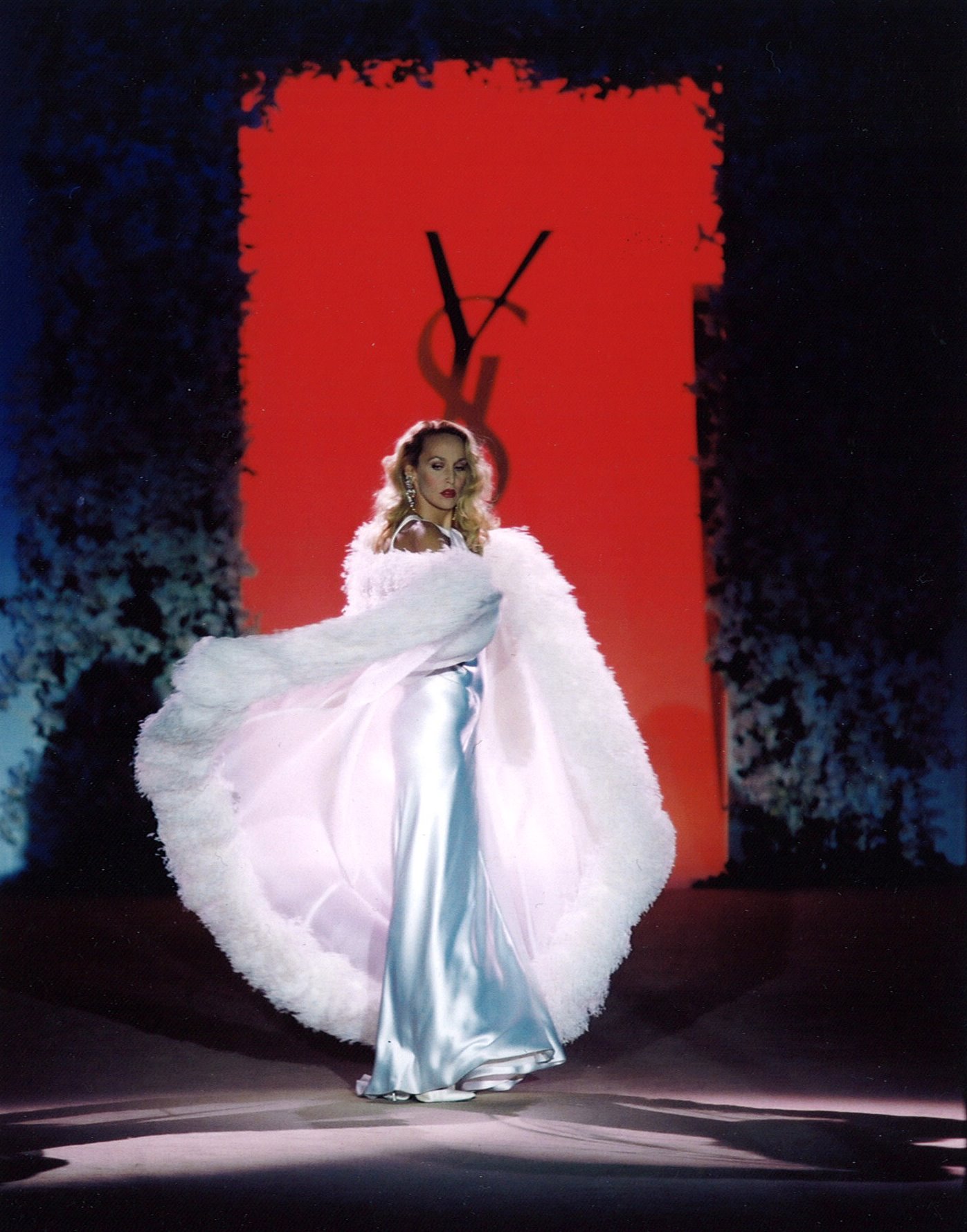 People sometimes watch the exaggerated television runway shows with a snicker and laugh and say “who would wear that?” But the fact it, while such designs fit a certain lifestyle and budget, and while some are purely theatric, the influence is a trickle down effect in term of color, cut, length, drape and a dozen tiny details. It’s the transition from haute couture to ready-to-wear. It sometimes takes a couple of years for high to recycle down the marketing food chain, but the influence of high fashion is out there in every piece of clothing — and art — we buy. Some make the transition better than others. St. Laurent was among the former. [Evening ensemble, 2001 Spring/Summer Collection, No. 89, Gauze Coat with Ostrich Feather border, satin crepe gown, Fondation Pierre Berge — Yves Saint Laurent, Photo: Foundation Pierre Berge — Yves Saint Laurent]
Yves Saint Laurent gave us flamboyant and romantic gowns of the 50s, 60s and early 70s when he worked in the House of Dior. He gave us some of the bold geometric “mini” designs of the 60s. He pioneered pantsuits for working women as the decade shifted to 1970. He was a visionary artist working in the finest linens, glistening silks and softest woolens. For fashion at his level is art. Saint Laurent “redefined” femininity with signature work that transcend the fashion norm.
The unique style of Yves Saint Laurent “blends references to the world of art with allusions to pop culture and social revolution.” The exhibit is structured around four themes and includes 145 accessorized creations along with drawings and videos (courtesy of Fondation Pierre Bergé – Yves Saint Laurent).
Director Nathalie Bondil sums up the new exhibit:
“Yves Saint Laurent is famed for revolutionizing the haute-couture tradition and laying the foundations of modern women’s wear. The wardrobe basics that he designed – pantsuit, culotte skirt, pea coat, blazer, safari jacket and tuxedo – shone with his innovative style and became true timeless classics. His designs were equally remarkable, reflecting wide-ranging sources of inspiration. In Saint Laurent’s stylistic vocabulary, music, art, performance, literature and impressions of far-off places were just as important as the new shapes he introduced…
“The poetry of each of his creations reflects this man’s incredible sensitivity and vast cultural knowledge. Every square inch of fabric is compelling…
Another aspect of Yves Saint Laurent’s work that touches me is his desire to empower women day and night. He appropriated masculine codes of dress, creating a wardrobe for modern women who were stepping out of traditional roles. This was in stark contrast to the practice of depicting women as Barbie dolls designed to sell products. But above all, he idealized the beauty of all his models, whatever their ethnic background or the colour of their skin (he was the first to use a black model), and his inspiration was nourished by a beautiful soul. Today, more than ever, young designers are re-examining his complex work.”
Exhibition Layout
Divided into the four themes, the exhibition begins with The Stroke of a Pencil”, that point of conception where the idea is created from the original sketch. The Yves Saint Laurent Revolution gives us the “feminized versions” of men’s attire with a touch of seductive appeal. The Palette explores a reversal of the traditional rules of colour harmony. Lyrical Sources brings the life cycle of fashion full circle to the sources of inspiration, sources rooted in the “historical, literary (Marcel Proust, Oscar Wilde, Louis Aragon, Jean Cocteau…) and artistic “influences” explored and interpreted in the genius that is Saint Laurent.
Throughout his career, Yves Saint Laurent examined the work of the great artists of our day, expressing his personal tastes and the paintings he admired by transforming painting into fabric. Some of his creations reflect the visual sensations of Impressionism, while others liberate the expressive power of some of the great names and movements of modern art: Mondrian and Poliakoff in 1965, the “Pop Art” dresses in 1966, Picasso in 1979 and Braque in 1988.
Exhibition Curators
The French fashion historian Florence Müller, Chief Curator of the exhibition, has shared her passion for and knowledge of French fashion and haute couture with Associate Curators Diane Charbonneau, Curator of Contemporary Decorative Arts at the Montreal Museum of Fine Arts, and Jill D’Alessandro, associate curator, Caroline and H. McCoy Jones Department of Textile Arts, Fine Arts Museums of San Francisco.
The museum is located at 1380 Sherbrooke Street West, Montreal, Quebec Canada with the mailing address at P.O. Box 3000, Station “H”, Montreal, Quebec Canada H3G 2T9.