

 With an economy in chaos, massive layoffs, and the skyrocketing cost of health insurance, one has to wonder… How can we save the American Way of Life? One that ensures peace, prosperity, and economic security in the post-Bush era? The answer to that question is the same now as it was when America was struggling to come out of the Great Depression: empower workers by giving them the right to form unions. There is a unique opportunity now to do just that as debate begins over one of the most important pieces of labor legislation to come through Washington in decades, the Employee Free Choice Act. This law, which some refer to as “EFCA”, would ensure that workers have a free choice to form a union and bargain with their employers for higher wages, benefits, and better working conditions. It would crack down on employers who routinely intimidate, bribe, and often fire pro-union workers as they try to form a union by addressing weaknesses in current U.S. labor law.
What you need to know right now, while the debate unfolds in Congress on the Employee Free Choice Act, is how right-wing conservatives, funded by corporate America, are lying to you about it. The big problem with EFCA, the Right tells us, is that it “takes away secret ballot elections” when a group of workers is deciding whether or not to form a union. Despite their hatred for secret ballot elections in their own boardrooms and shareholder meetings, America’s CEO’s now suddenly have a new appreciation for the democratic process when it comes to this law and are demanding that the “secret ballot” be preserved in union organizing drives.
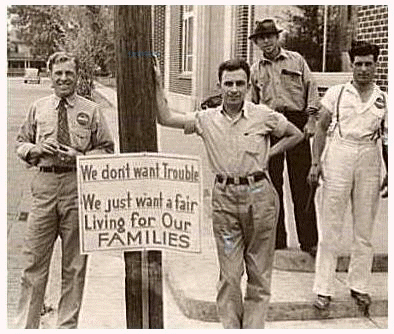 As you might imagine, EFCA’s anti-labor advocates are misrepresenting the bill. A key provision of the Employee Free Choice Act is that workers, (not Management) get to decide whether there will be an election at all or use what’s called “majority sign-up” (also known as “card-check”). The “secret ballot” isn’t going anywhere, it just allows for another option and that the workers, not the CEO’s get to make the decision on which method to use.
Now, you may ask yourself, “why would anybody not want to have a secret ballot election?” That’s a fair enough question. After all, free and fair elections are the cornerstone of our democracy. But under the current company-dominated system, union elections are anything but free and fair. The key is the timeline. Right now, it’s the companies that get to decide when the election is held. They often decide to hold the election many months or years into the future, which gives them time to identify, harass, intimidate, and terminate workers who may want to form a union. Think of it this way. Imagine if George W. Bush – realizing that John McCain was going to lose on November 4, just decided to put the presidential election off for a year, hoping that the political winds would change, that the economy would improve, or that Barack Obama might get hit by a bus. Would that seem fair? That’s currently the system that exists under U.S. labor law. The companies get to set the rules and the timelines – the workers have no say. The Employee Free Choice Act threatens business’ control over the process and this is what truly horrifies them.
There is also the matter of whether an election is even needed at all. The other key provision of the Employee Free Choice Act is to recognize majority sign-up. What that means is that if a majority of workers at a company indicate their preference for forming a union by signing an authorization card, then the union must be recognized by all parties involved. What’s the difference between majority sign-up and an election? Not much. Both indicate the will of what the employees’ wishes are. Again we go back to the timeline. Majority sign-up denies Management the time they need to intimidate and fire pro-union employees. Currently an employer can demand a secret ballot election even if a majority of employees has signed authorization cards.
The Employee Free Choice Act in its current form will ultimately be one of the best pieces of pro-worker legislation in a half-century and is the single biggest threat to corporate dominance over working men and women. For that reason – not some bogus threat to a “secret ballot” – expect our well-financed adversaries to say anything to stop it.



It sounds as though I agree with most of what the bill states. I am a simple man though. Why can’t it say that when it comes down to actually voting on an item that the vote is private. That way no one knows how someone may have voted on way or the other. Your left wing bias won’t win over any moderates with the way you word your articles.
OK, Ortho – I’ll say it right here since I didn’t in my article…
When it comes down to actually voting on an item, the vote is private.
I agree with you. Does that mean I have a “left-wing bias”?
In any case, the privacy of the vote has absolutely nothing to do with what I wrote or what is actually in the Employee Free Choice Act legislation. Here’s the link, if you want to read it yourself:
http://thomas.loc.gov/cgi-bin/query/z?c111:H.R.1409:
Specifically, Section 2 (a,6) says that if a majority indicates that they wish to have a union, that they should have it and that there need not be an election.
So Ortho, I do believe that the vote is sacred and should be private (even though both political parties hold caucus elections that require a show of hands, as do most corporate boards), but you’ve been fooled into thinking that the secret ballot is somehow “at risk” with EFCA. It’s not. All the bill does is permit employees to sidestep an election if a majority of them are in agreement that they want a union. I’ve already explained why that’s needed (management uses that time period to intimidate, bribe, and fire people) and that the real threat is the loss of Management’s control over the process.
And I am not hoping to “win over any moderates” with how I “word my articles”. I am telling the truth about the legislation, which is not what the EFCA opponents have done. I have faith in “moderates” to make the right decision once they have all the facts.
“Specifically, Section 2 (a,6) says that if a majority indicates that they wish to have a union, that they should have it and that there need not be an election.”
Gee… why don’t we do this for local mayors and city councils, too? Sure would save money. First candidate to get 50% of the voters to sign their petition gets to be mayor. And everybody’s signature will be public, so everyone in your neighborhood will know how you “voted.”
Peace and harmony abounding…