

 The House GOP Review is a weekly feature that gives Tennesseans an in-depth look at what our Republican state legislators have been working on this week, and a glimpse into what’s planned for the coming week at our state house. This week’s highlights:
- Charter Schools
- SJR 127 (Abortion)
- Crime
- Swine Flu
House panel discusses possible charter school changes
The House Education committee discussed at length this week the pros and cons of several bills that seek to expand eligibility for public charter schools. In addition, the legislation discussed also clarifies funding and addresses rules for renewal of the public charter schools.Tennessee currently has one of the most restrictive public charter school laws in the nation.
Charter schools are public schools that are given flexibility to operate without the constraints of some of the rules and regulations normally imposed on traditional schools. In exchange for this flexibility, they are held accountable for performance through a charter, which is an agreement between the local education agency (LEA) and the charter school. It requires a strenuous approval process by the LEA and an equally tough renewal process of the charter every five years. Many of the speakers that testified before the committee praised Tennessee’s stringent accountability measures, that ensure the schools are performing well.
A report released last year by Tennessee’s Comptroller’s Office titled “Tennessee’s Charter Schools: Issues of Innovation and Sustainability,” found student eligibility restrictions and limited facilities funding may compromise the long-term viability of individual charter schools and recommended many of the changes included in the bills. The report recommended that the General Assembly consider making eligibility for charter school enrollment less restrictive and consider more precisely defining state and local charter school facilities funding responsibilities. In addition, the report recommended that the state should also identify charter schools’ best practices and implement a system for disseminating that information to traditional schools.
The bills that are currently before the committee address four main components of the public charter school law:
- Eligibility — Currently, public charter school enrollment is limited primarily to failing students and those from failing schools. This legislation permits “at-risk” children (as defined by free and reduced-price lunch) to attend charter schools in those systems that have 12,000 or more students.
- Caps — Currently public charter schools are limited to 50 statewide, with a cap of 20 in Memphis. This bill says that converted charter schools do not count against the cap, clarifying in law what the Attorney General has already opined.
- Renewal process – Currently, the charter agreement between the LEA and the charter school is renewed every five years. This measure would change the renewal period from five to ten years, as well as establishes the required documentation needed during the renewal process.
- Funding – Currently a public charter school receives the per pupil expenditure of state and local dollars. Although it mentions appropriate federal dollars, interpretations vary from one LEA to the next. This legislation defines the state and local charter school facilities funding responsibilities and clarifies the LEAs must allocate all appropriate federal funds, including Title I and ESEA funds, to the charter schools.
Tennessee now has 15 public charter schools, with six more opening in the fall. Of those 22 schools, Nashville will have five, Chattanooga will have two, and Memphis will have 15. The Memphis City School System also is converting four schools to charters this fall.
SJR 127 clears another hurdle; in Finance next week
Senate Joint Resolution 127 cleared another hurdle this week, facing little opposition in the Budget Subcommittee. The constitutional amendment carries a $20,000 price tag for the cost incurred to put notice in newspapers across the state that the amendment will be on the ballot. committee members were given a memo from Secretary of State Tre Hargett stating that his office will absorb the cost within their existing budget so that the legislature does not have to allocate funds in a time of budget shortfall. The move is not unprecedented; in 2006, former Secretary of State Riley Darnell paid the same amount for an amendment proposal to define marriage to go on the ballot.
The constitutional amendment is in response to the 2001 Tennessee Supreme Court decision in Planned Parenthood vs Sundquist, when the court created a right to unregulated abortion. The decision also prohibited the Tennessee legislature from enacting any regulations governing abortions, arguably making Tennessee the most liberal in the nation with regards to abortion laws.
Although the constitutional amendment has achieved passage in the Senate before, it has never cleared the hurdle of the Public Health Subcommittee in the House.
Republicans have argued for several years that SJR 127 would simply allow the people of the state to weigh in on the issue. The sponsor said there was a “powerful and pivotal passage in our state’s constitution which stated that power was inherent in the people,” and argued that in the past, the initial vote of six in a subcommittee silenced six million Tennesseans.
If passed this year by the 106th General Assembly by a simple majority, it must pass the 107th General Assembly by two-thirds before appearing on the ballot in 2014.
Republicans initiatives get tough on crime
Three Republican sponsored crime bills passed out of the House Judiciary committee this week, and are now headed to the Budget Subcommittee. Despite having fiscal notes, the sponsors said the measures are desperately needed for the safety of Tennesseans to keep violent repeat offenders off the street.
House Bill 241 aims to keep violent offenders incarcerated longer than they are currently required. If passed, someone convicted of aggravated robbery—whether it is a first offense or not—would be require to serve no less than 85 percent of their sentence. House Bill 525 broadens the offense of first degree felony murder to include the killing of another person while committing domestic abuse if there was a past pattern of abuse of the victim or of another member of the victim’s family. In the same vein, House Bill 526 increases the penalty for a fourth or subsequent violation of domestic assault to a Class E felony. Domestic assault is currently punished as assault which can be either a Class A or Class B misdemeanor.
Tennessee Department of Health and Human Services distributes swine flu information
The Tennessee Department of Health and Human Services (HHS) distributed information regarding the swine flu to legislative members’ offices this week, in an effort to educate the public on how to protect themselves.
HHS said Tennessee residents who think they may be ill with the flu or flu-like illness should contact a doctor. Symptoms of the illness are as follows: fever, body aches, runny nose, sore throat, nausea, or vomiting. Your doctor will determine whether influenza testing or treatment is needed. If you become ill and experience any warning signs, seek emergency medical care.
The Department of Health also recommended frequent hand washing with warm soapy water, keeping hands away from your face, eyes and mouth, and covering coughs and sneezes with a sleeve or tissue. These precautions can also help prevent the spread of other illnesses.
For more information, contact your representative’s office.
In case you missed it…
- House Bill 738, the “Tennessee Energy Conservation Endorsement Act of 2009,” was passed out of the House Commerce committee this week. The bill classifies the “engaging in energy conservation programs and measures that conserve, as well as distribute, electrical energy and supplies of natural gas, oil and other fuels” as a proper and essential function of public utilities. The legislation also authorizes the Tennessee Regulatory Authority (TRA) to develop energy conservation programs.
- House Bill 431 was passed by the Education committee this week, with a 14-5 vote. The Republican bill seeks to expand the recognition of homeschoolers’ diplomas. The legislation requires that diplomas issued by home schools be recognized by all state and local governmental entities as having the same rights and privileges of diplomas issued by public school systems.
- Legislation that would prohibit sending or reading text messages while driving passed both the House and Senate this week. Members discussed House Bill 107 at length as to whether or not the possibility that texting while driving fell under the “distracted driving” statute, but ultimately determined that the legislation would clarify the law and allow law enforcement some discretion.
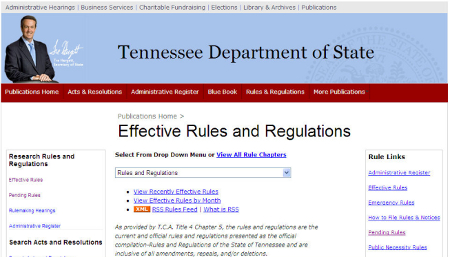
- Secretary of State Tre Hargett has added a new tool to his office’s web site to make it easier for people to track pending rules and regulations issued by the state’s regulatory agencies, according to officials testifying in the Joint Government Operations committee. It’s now possible to get updates on pending rules and regulations by subscribing to the Pending Rules and Regulations RSS Feed. This new tool complements the current Pending Rules and Regulations Online Database. The new service allows citizens to stay updated on rules that have been filed with the secretary, to give business owners advance notice of pending rules. (tnsos.org/rules)
The week ahead…
| House Bill 962 Conference committee | 2:00 p.m. Monday | Legislative Plaza Room 31 |
| House Session | 4:00 p.m. Monday | House Chambers |
| House Session | 9:00 a.m. Thursday, May 7 | House Chambers |
| Tuesday, May 5, 2009 | ||
|---|---|---|
| Committee or Subcommittee | Time | Room Number |
| Calendar & Rules committee | 8:00 a.m. | Legislative Plaza 16 |
| Higher Education Subcommittee | 8:30 a.m. | Legislative Plaza 29 |
| Professional Occupations Subcommittee | 8:30 a.m. | Legislative Plaza 31 |
| Small Business Subcommittee | 9:00 a.m. | Legislative Plaza 16 |
| Commerce committee | 9:15 a.m. | Legislative Plaza 16 |
| Agriculture committee | 9:15 a.m. | Legislative Plaza 29 |
| Health & Human Resources committee | 10:30 a.m. | Legislative Plaza 16 |
| Consumer & Employee Affairs committee | 10:30 a.m. | Legislative Plaza 29 |
| Utilities & Banking Subcommittee | 10:30 a.m. | Legislative Plaza 30 |
| Environment Subcommittee | 11:00 a.m. | Legislative Plaza 29 |
| State & Local Government committee | 12:00 p.m. | Legislative Plaza 16 |
| Civil Practice & Procedure Subcommittee | 12:00 p.m. | Legislative Plaza 31 |
| Finance, Ways & Means committee | 1:30 p.m. | Legislative Plaza 16 |
| Employee Affairs Subcommittee | 1:30 p.m. | Legislative Plaza 29 |
| Transportation committee | 3:00 p.m. | Legislative Plaza 16 |
| Consumer & Employee Affairs committee | 3:00 p.m. | Legislative Plaza 29 |
| Public Safety Subcommittee | After Trans | Legislative Plaza 16 |
| Public Health Subcommittee | 4:00 p.m. | Legislative Plaza 30 |
| Wednesday, May 6, 2009 | ||
| Committee or Subcommittee | Time | Room Number |
| Calendar & Rules (TBA) | 8:00 a.m. | Legislative Plaza 16 |
| Children & Family Affairs committee | 8:30 a.m. | Legislative Plaza 16 |
| State Government Subcommittee | 8:30 a.m. | Legislative Plaza 29 |
| Judiciary committee | 8:30 a.m. | Legislative Plaza 31 |
| K-12 Education Subcommittee | 10:00 a.m. | Legislative Plaza 16 |
| Government Operations committee | 10:00 a.m. | Legislative Plaza 29 |
| Industrial Impact Subcommittee | 10:00 a.m. | Legislative Plaza 30 |
| Education committee | 11:00 a.m. | Legislative Plaza 16 |
| Budget Subcommittee | 11:00 a.m. | Legislative Plaza 29 |
| Criminal Practice & Procedure Subcommittee | 12:00 p.m. | Legislative Plaza 31 |
| K-12 Education Subcommittee (2nd half) | 1:30 p.m. | Legislative Plaza 16 |
| Budget Study Subcommittee | 1:30 p.m. | Legislative Plaza 29 |
| Civil Practice & Procedure Subcommittee | 2:00 p.m. | Legislative Plaza 16 |
| Local Government Subcommittee | 2:30 p.m. | Legislative Plaza 29 |
| Government Operations committee | (2nd half) 2:30 p.m. | Legislative Plaza 30 |