

 Montgomery County is currently under a flood warning. The crest is expected to reach 54.6′ on May 3rd at 6:00 am on the Cumberland River at Clarksville, TN. Currently the river is at 47.66′, a level not reached since February 17th 2003.
Several people have died across Tennessee from these storms and extreme caution should be used when you are around flooded areas. You should avoid driving through flood water when it crosses the road, you never know how deep it actually is! In Nashville Tennessee 70 vehicles were submerged on I-24 in Antioch and one person died as a result, two more died in Stewart County, two other deaths were reported in Williamson and Carroll counties.
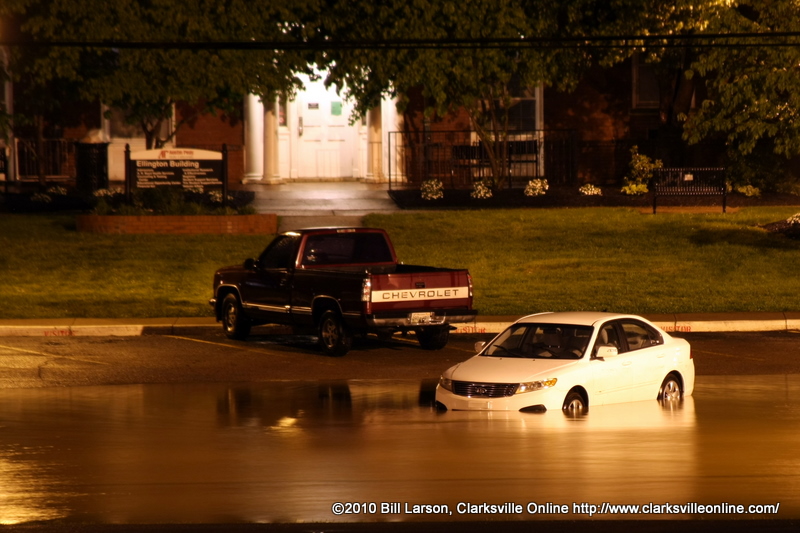
Jeremy Heidt spokesman for the Tennessee Emergency Management Agency reported that some areas had gotten up to 10 inches of rain by Saturday afternoon and even more was expected.
The Montgomery County Chapter of the American Red Cross reports that they have activated an emergency shelter in Erin, while in Clarksville emergency hotel rooms and other shelters are filled to capacity. They can use your help and support. Make a donation today! Please Be sure to specify that your donation is for the Montgomery County branch of the American Red Cross.
The National Weather Service offers Flood Tips
 Each year, more deaths occur due to flooding than from any other thunderstorm related hazard. Why? The main reason is people underestimate the force and power of water. Many of the deaths occur in automobiles as they are swept downstream. Of these drownings, many are preventable, but too many people continue to drive around the barriers that warn you the road is flooded.
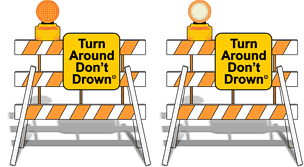
Whether you are driving or walking, if you come to a flooded road, Turn Around Don’t Drown. You will not know the depth of the water nor will you know the condition of the road under the water.
Water covering the road can create an impassable barrier.
Follow these safety rules:
- Monitor the NOAA Weather Radio, or your favorite news source for vital weather related information.
- If flooding occurs, get to higher ground. Get out of areas subject to flooding. This includes dips, low spots, canyons, washes etc.
- Avoid areas already flooded, especially if the water is flowing fast. Do not attempt to cross flowing streams. Turn Around Don’t Drown
- Road beds may be washed out under flood waters. NEVER drive through flooded roadways. Turn Around Don’t Drown If your vehicle is suddenly caught in rising water, leave it immediately and seek higher ground.
- Do not camp or park your vehicle along streams and washes, particularly during threatening conditions.
- Be especially cautious at night when it is harder to recognize flood dangers.
Flash Floods
Except for heat related fatalities, more deaths occur from flooding than any other hazard. Why? Most people fail to realize the power of water. For example, six inches of fast-moving flood water can knock you off your feet.
While the number of fatalities can vary dramatically with weather conditions from year to year, the national 30-year average (1977-2006) for flood deaths is 99. That compares with a 30-year average of 61 deaths for lightning, 54 for tornadoes and 49 for hurricanes.
National Weather Service data also shows:
- Nearly half of all flash flood fatalities are vehicle-related,
- The majority of victims are males, and
- Flood deaths affect all age groups.
Most flash floods are caused by slow moving thunderstorms, thunderstorms that move repeatedly over the same area or heavy rains from tropical storms and hurricanes. These floods can develop within minutes or hours depending on the intensity and duration of the rain, the topography, soil conditions and ground cover.
Flash floods can roll boulders, tear out trees, destroy buildings and bridges, and scour out new channels. Rapidly rising water can reach heights of 30 feet or more. Furthermore, flash flood-producing rains can also trigger catastrophic mud slides.
Occasionally, floating debris or ice can accumulate at a natural or man-made obstruction and restrict the flow of water. Water held back by the ice jam or debris dam can cause flooding upstream. Subsequent flash flooding can occur downstream if the obstruction should suddenly release.