

Written by Bill Steigerwald
NASA’s Goddard Space Flight Center
 Greenbelt, MD – NASA’s Lunar Reconnaissance Orbiter (LRO) spacecraft has returned data that indicate ice may make up as much as 22 percent of the surface material in a crater located on the moon’s south pole.
The team of NASA and university scientists using laser light from LRO’s laser altimeter examined the floor of Shackleton crater. They found the crater’s floor is brighter than those of other nearby craters, which is consistent with the presence of small amounts of ice. This information will help researchers understand crater formation and study other uncharted areas of the moon. The findings are published in Thursday’s edition of the journal Nature.
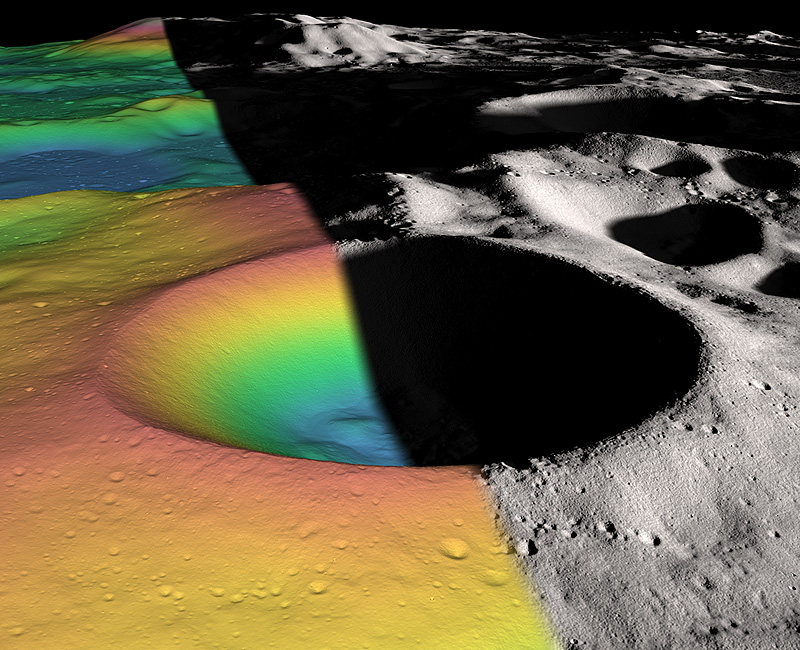
The spacecraft mapped Shackleton crater with unprecedented detail, using a laser to illuminate the crater’s interior and measure its albedo or natural reflectance. The laser light measures to a depth comparable to its wavelength, or about a micron. That represents a millionth of a meter, or less than one ten-thousandth of an inch. The team also used the instrument to map the relief of the crater’s terrain based on the time it took for laser light to bounce back from the moon’s surface. The longer it took, the lower the terrain’s elevation.
[youtube]http://www.youtube.com/watch?v=kopY91AOvx4[/youtube]
In addition to the possible evidence of ice, the group’s map of Shackleton revealed a remarkably preserved crater that has remained relatively unscathed since its formation more than three billion years ago. The crater’s floor is itself pocked with several small craters, which may have formed as part of the collision that created Shackleton.
“The crater’s interior is extremely rugged,” said Maria Zuber, the team’s lead investigator from the Massachusetts Institute of Technology in Cambridge in Mass. “It would not be easy to crawl around in there.”
While the crater’s floor was relatively bright, Zuber and her colleagues observed that its walls were even brighter. The finding was at first puzzling. Scientists had thought that if ice were anywhere in a crater, it would be on the floor, where no direct sunlight penetrates.
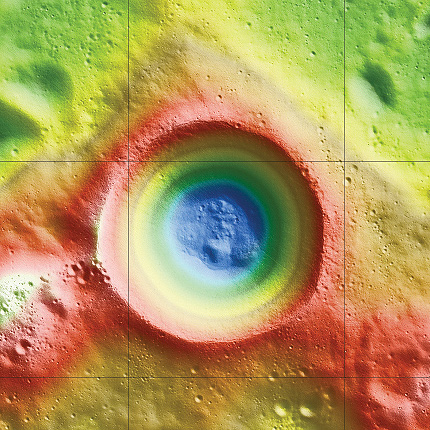 The upper walls of Shackleton crater are occasionally illuminated, which could evaporate any ice that accumulates. A theory offered by the team to explain the puzzle is that “moonquakes”– seismic shaking brought on by meteorite impacts or gravitational tides from Earth — may have caused Shackleton’s walls to slough off older, darker soil, revealing newer, brighter soil underneath. Zuber’s team’s ultra-high-resolution map provides strong evidence for ice on both the crater’s floor and walls.
“There may be multiple explanations for the observed brightness throughout the crater,” said Zuber. “For example, newer material may be exposed along its walls, while ice may be mixed in with its floor.”
The initial primary objective of LRO was to conduct investigations that prepare for future lunar exploration. Launched in June 2009, LRO completed its primary exploration mission and is now in its primary science mission. LRO was built and is managed by Goddard. This research was supported by NASA’s Human Exploration and Operations Mission Directorate and Science Mission Directorate at the agency’s headquarters in Washington.
For more information on LRO and the Lunar Orbiter Laser Altimeter, visit: http://lunar.gsfc.nasa.gov
About NASA’s Lunar Reconnaissance Orbiter (LRO)
The initial primary objective of LRO was to conduct investigations that prepare for future lunar exploration. Launched in June 2009, LRO completed its primary exploration mission and is now in its primary science mission. LRO was built and is managed by Goddard. This research was supported by NASA’s Human Exploration and Operations Mission Directorate and Science Mission Directorate at the agency’s headquarters in Washington.
The spacecraft mapped Shackleton crater with unprecedented detail, using a laser to illuminate the crater’s interior and measure its albedo or natural reflectance. The laser light measures to a depth comparable to its wavelength, or about a micron. That represents a millionth of a meter, or less than one ten-thousandth of an inch. The team also used the instrument to map the relief of the crater’s terrain based on the time it took for laser light to bounce back from the moon’s surface. The longer it took, the lower the terrain’s elevation.