

Written by Jia-Rui C. Cook
NASA’s Jet Propulsion Laboratory
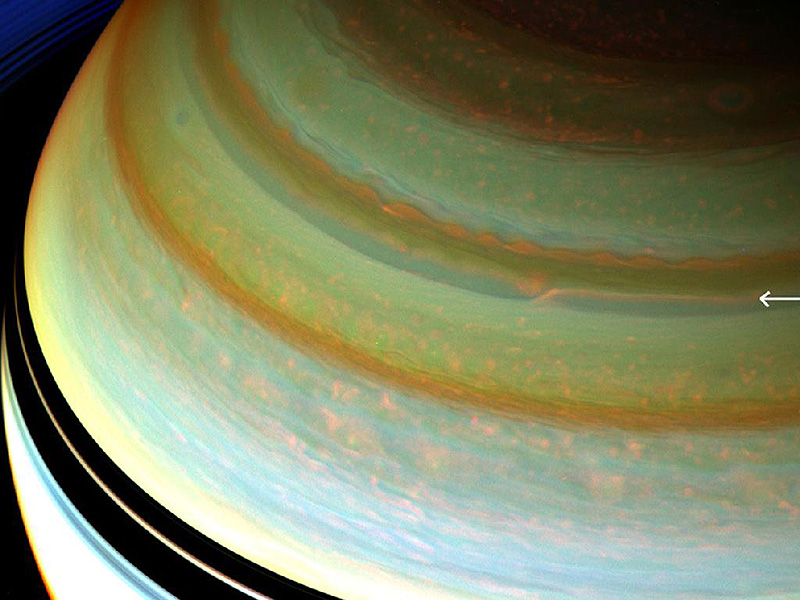
 Pasadena, CA – Turbulent jet streams, regions where winds blow faster than in other places, churn east and west across Saturn. Scientists have been trying to understand for years the mechanism that drives these wavy structures in Saturn’s atmosphere and the source from which the jets derive their energy.
In a new study appearing in the June edition of the journal Icarus, scientists used images collected over several years by NASA’s Cassini spacecraft to discover that the heat from within the planet powers the jet streams.
A competing theory had assumed that the energy for the temperature differences came from the sun. That is how it works in the Earth’s atmosphere.
“We know the atmospheres of planets such as Saturn and Jupiter can get their energy from only two places: the sun or the internal heating. The challenge has been coming up with ways to use the data so that we can tell the difference,” said Tony Del Genio of NASA’s Goddard Institute for Space Studies, NY, the lead author of the paper and a member of the Cassini imaging team.
The new study was possible in part because Cassini has been in orbit around Saturn long enough to obtain the large number of observations required to see subtle patterns emerge from the day-to-day variations in weather.
“Understanding what drives the meteorology on Saturn, and in general on gaseous planets, has been one of our cardinal goals since the inception of the Cassini mission,” said Carolyn Porco, imaging team lead, based at the Space Science Institute, Boulder, CO. “It is very gratifying to see that we’re finally coming to understand those atmospheric processes that make Earth similar to, and also different from, other planets.”
Rather than having a thin atmosphere and solid-and-liquid surface like Earth, Saturn is a gas giant whose deep atmosphere is layered with multiple cloud decks at high altitudes. A series of jet streams slice across the face of Saturn visible to the human eye and also at altitudes detectable to the near-infrared filters of Cassini’s cameras. While most blow eastward, some blow westward. Jet streams occur on Saturn in places where the temperature varies significantly from one latitude to another.
In the new study, which is a follow-up to results published in 2007, the authors used automated cloud tracking software to analyze the movements and speeds of clouds seen in hundreds of Cassini images from 2005 through 2012.
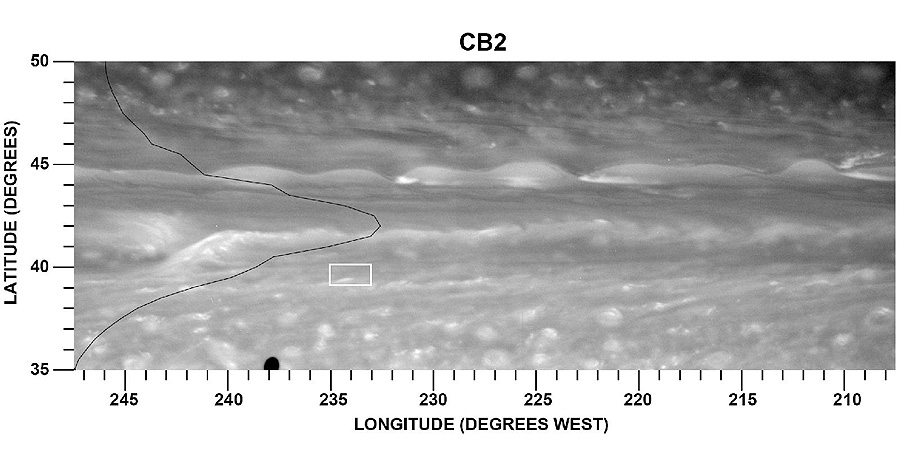
“With our improved tracking algorithm, we’ve been able to extract nearly 120,000 wind vectors from 560 images, giving us an unprecedented picture of Saturn’s wind flow at two independent altitudes on a global scale,” said co-author and imaging team associate John Barbara, also at the Goddard Institute for Space Studies. The team’s findings provide an observational test for existing models that scientists use to study the mechanisms that power the jet streams.
By seeing for the first time how these eddies accelerate the jet streams at two different altitudes, scientists found the eddies were weak at the higher altitudes where previous researchers had found that most of the sun’s heating occurs. The eddies were stronger deeper in the atmosphere. Thus, the authors could discount heating from the sun and infer instead that the internal heat of the planet is ultimately driving the acceleration of the jet streams, not the sun.
The condensation of water was not actually observed; most of that process occurs at lower altitudes not visible to Cassini. But the condensation in mid-latitude storms does happen on both Saturn and Earth. Storms on Earth – the low- and high-pressure centers on weather maps – are driven mainly by the sun’s heating and do not mainly occur because of the condensation of water, Del Genio said. On Saturn, the condensation heating is the main driver of the storms, and the sun’s heating is not important.
Images of one of the strongest jet streams and a figure from the paper can be found at http://www.nasa.gov/cassini , http://saturn.jpl.nasa.gov and http://ciclops.org .
The Cassini-Huygens mission is a cooperative project of NASA, the European Space Agency and the Italian Space Agency. The Jet Propulsion Laboratory, a division of the California Institute of Technology in Pasadena, manages the Cassini-Huygens mission for NASA’s Science Mission Directorate, Washington. The Cassini orbiter and its two onboard cameras were designed, developed and assembled at JPL. The imaging team is based at the Space Science Institute in Boulder, CO.