

Written by Whitney Clavin
NASA’s Jet Propulsion Laboratory
 Pasadena, CA – Seeing is believing, except when you don’t believe what you see. Astronomers using NASA’s Hubble Space Telescope have found a puzzling arc of light behind an extremely massive cluster of galaxies residing 10 billion light-years away. The galactic grouping, discovered by NASA’s Spitzer Space Telescope, was observed as it existed when the universe was roughly a quarter of its current age of 13.7 billion years.
The giant arc is the stretched shape of a more distant galaxy whose light is distorted by the monster cluster’s powerful gravity, an effect called gravitational lensing. The trouble is, the arc shouldn’t exist.
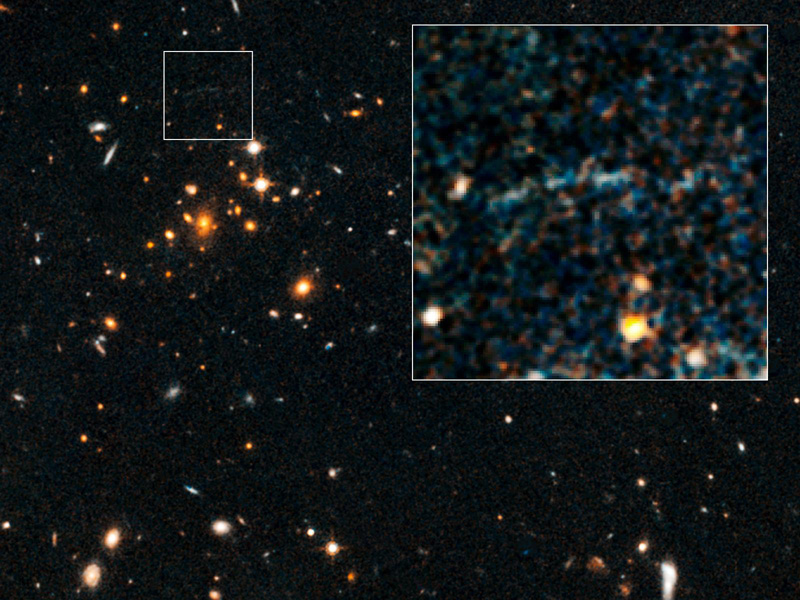
Galaxy clusters are collections of hundreds to thousands of galaxies bound together by gravity. They are the most massive structures in our universe. Astronomers frequently study galaxy clusters to look for faraway, magnified galaxies behind them that would otherwise be too dim to see with telescopes. Many such gravitationally lensed galaxies have been found behind galaxy clusters closer to Earth.
The surprise in this Hubble observation is spotting a galaxy lensed by an extremely distant cluster. Dubbed IDCS J1426.5+3508, the cluster is the most massive found at that epoch, weighing as much as 500 trillion suns. It is 5 to 10 times larger than other clusters found at such an early time in the history of the universe. The team spotted the cluster in a search using NASA’s Spitzer Space Telescope in combination with archival optical images taken as part of the National Optical Astronomy Observatory’s Deep Wide Field Survey at the Kitt Peak National Observatory, Tucson, Ariz. The combined images allowed them to see the cluster as a grouping of very red galaxies, indicating they are far away.
This unique system constitutes the most distant cluster known to “host” a giant gravitationally lensed arc. Finding this ancient gravitational arc may yield insight into how, during the first moments after the Big Bang, conditions were set up for the growth of hefty clusters in the early universe.
Once the astronomers determined the cluster’s distance, they used Hubble, the Combined Array for Research in Millimeter-wave Astronomy (CARMA) radio telescope, and NASA’s Chandra X-ray Observatory to independently show that the galactic grouping is extremely massive.
“The chance of finding such a gigantic cluster so early in the universe was less than one percent in the small area we surveyed,” said team member Mark Brodwin of the University of Missouri-Kansas City. “It shares an evolutionary path with some of the most massive clusters we see today, including the Coma cluster and the recently discovered El Gordo cluster.”
An analysis of the arc revealed that the lensed object is a star-forming galaxy that existed 10 billion to 13 billion years ago. The team hopes to use Hubble again to obtain a more accurate distance to the lensed galaxy.
The team’s results are described in three papers, which will appear online today and will be published in the July 10, 2012 issue of The Astrophysical Journal. Gonzalez is the first author on one of the papers; Brodwin, on another; and Adam Stanford of the University of California at Davis, on the third. Daniel Stern and Peter Eisenhardt of JPL are co-authors on all three papers.
JPL manages the Spitzer Space Telescope mission for NASA’s Science Mission Directorate, Washington. Science operations are conducted at the Spitzer Science Center at the California Institute of Technology in Pasadena. Data are archived at the Infrared Science Archive housed at the Infrared Processing and Analysis Center at Caltech. Caltech manages JPL for NASA. For more information about Spitzer, visit http://spitzer.caltech.edu and http://www.nasa.gov/spitzer .