

Written by Whitney Clavin
NASA’s Jet Propulsion Laboratory
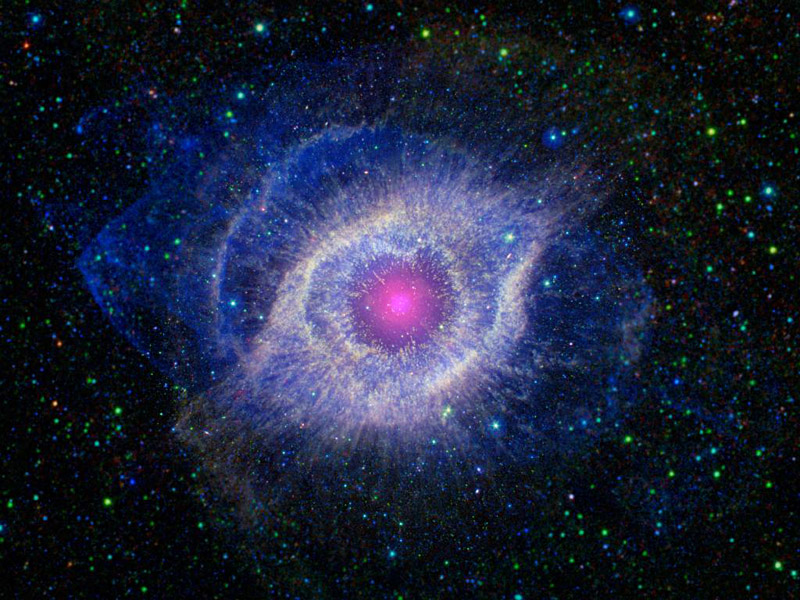
 Pasadena, CA – A dying star is refusing to go quietly into the night, as seen in this combined infrared and ultraviolet view from NASA’s Spitzer Space Telescope and the Galaxy Evolution Explorer (GALEX), which NASA has lent to the California Institute of Technology in Pasadena.
In death, the star’s dusty outer layers are unraveling into space, glowing from the intense ultraviolet radiation being pumped out by the hot stellar core.
Planetary nebulae are actually the remains of stars that once looked a lot like our sun. These stars spend most of their lives turning hydrogen into helium in massive runaway nuclear fusion reactions in their cores. In fact, this process of fusion provides all the light and heat that we get from our sun. Our sun will blossom into a planetary nebula when it dies in about five billion years.
When the hydrogen fuel for the fusion reaction runs out, the star turns to helium for a fuel source, burning it into an even heavier mix of carbon, nitrogen and oxygen. Eventually, the helium will also be exhausted, and the star dies, puffing off its outer gaseous layers and leaving behind the tiny, hot, dense core, called a white dwarf. The white dwarf is about the size of Earth, but has a mass very close to that of the original star; in fact, a teaspoon of a white dwarf would weigh as much as a few elephants!
The intense ultraviolet radiation from the white dwarf heats up the expelled layers of gas, which shine brightly in the infrared. GALEX has picked out the ultraviolet light pouring out of this system, shown throughout the nebula in blue, while Spitzer has snagged the detailed infrared signature of the dust and gas in red, yellow and green. Where red Spitzer and blue GALEX data combine in the middle, the nebula appears pink.
A portion of the extended field beyond the nebula, which was not observed by Spitzer, is from NASA’s all-sky Wide-field Infrared Survey Explorer (WISE). The white dwarf star itself is a tiny white pinprick right at the center of the nebula.
More information about Spitzer is online at http://spitzer.caltech.edu and http://www.nasa.gov/spitzer . More information about GALEX is at http://www.galex.caltech.edu .