

 Atlanta, GA – The Centers for Disease Control and Prevention (CDC), in collaboration with state and local health departments and the Food and Drug Administration (FDA), is investigating a multistate fungal meningitis outbreak among patients who received contaminated steroid injections.
Several patients suffered strokes that are believed to have resulted from their infections. The investigation also includes fungal infections associated with injections in a peripheral joint, such as a knee, shoulder or ankle.
Patients who received injections in peripheral joints only are not believed to be at risk for meningitis, but they could be at risk for joint infection.
At A Glance
Status: Ongoing Investigation
Infection: Fungal
Facility Type: Outpatient Setting
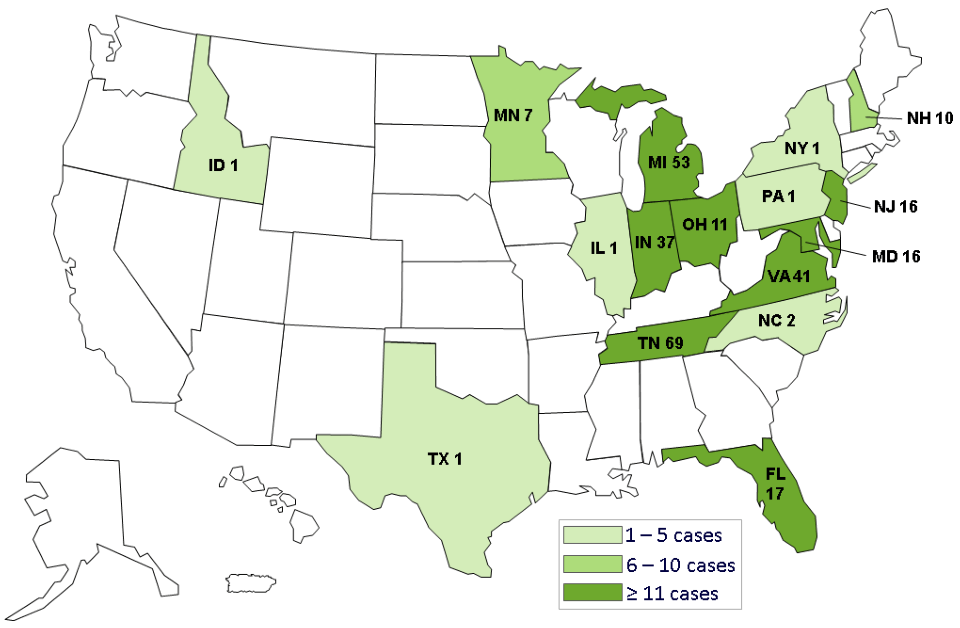
Case Count: 284
States: 16
Deaths: 23
Case Table by State
| State | Case Count | Deaths |
|---|---|---|
| Florida (FL) | 17 | 3 |
| Idaho (ID) | 1 | 0 |
| Illinois (IL) | 1 | 0 |
| Indiana (IN) | 37 | 2 |
| Maryland (MD) | 16 | 1 |
| Michigan (MI) | 53 | 5 |
| Minnesota (MN) | 7 | 0 |
| New Hampshire (NH) | 10 | 0 |
| New Jersey (NJ) | 16 | 0 |
| New York (NY) | 1 | 0 |
| North Carolina (NC) | 2 | 1 |
| Ohio (OH) | 11 | 0 |
| Pennsylvania (PA) | 1 | 0 |
| Tennessee (TN) | 69 | 9 |
| Texas (TX) | 1 | 0 |
| Virginia (VA) | 41 | 2 |
| TOTALS | 284* | 23 |
About the Investigation
CDC and FDA have confirmed the presence of a fungus known as Exserohilum rostratum in unopened medication vials of preservative-free methylprednisolone acetate (80mg/ml) from one of the three implicated lots from NECC (Lot #08102012@51, BUD 2/6/2013). The laboratory confirmation further links steroid injections from these lots from NECC to the multistate outbreak of fungal meningitis and joint infections. Testing on the other two implicated lots of methylprednisolone acetate and other NECC injectable medications continues.
As of October 17th, 2012, a total of 47 patients have laboratory-confirmed fungal meningitis. This form of fungal meningitis is not contagious. CDC’s laboratory has confirmed Exserohilum rostratum in clinical specimens for all but two patients of these patients. Of the other two patients, one has been found to be infected with Aspergillus fumigatus and one with Cladosporium. These fungi are common in the environment but rarely cause meningitis.
CDC continues to work with states to determine if there may be other fungal infections caused by exposure to NECC products beyond the three lots of preservative-free methylprednisolone acetate (80mg/ml) from NECC that were recalled on September 26th, 2012. CDC does not have firm evidence that fungal infections have been caused by exposure to other NECC products.
Patients and clinicians need to remain vigilant for onset of symptoms because fungal infections can be slow to develop. In this outbreak symptoms typically have appeared 1 to 4 weeks following injection, but it’s important to know that longer and shorter periods of time between injection and onset of symptoms have been reported. Therefore, patients and physicians need to closely watch for symptoms for at least several months following the injection. See updated Patient Guidance for more information, and contact your physician if you are concerned you may have become ill from your injection.
Information about the investigation and guidance for clinicians, including interim treatment guidelines, is available at http://www.cdc.gov/hai/outbreaks/meningitis.html. CDC recommendations are subject to change as more information becomes available.