

Written by Alan Buis
NASA’s Jet Propulsion Laboratory
 Pasadena, CA – NASA’s newest set of X-ray eyes in the sky, the Nuclear Spectroscopic Telescope Array (NuSTAR), has caught its first look at the giant black hole parked at the center of our galaxy. The observations show the typically mild-mannered black hole during the middle of a flare-up.
“We got lucky to have captured an outburst from the black hole during our observing campaign,” said Fiona Harrison, the mission’s principal investigator at the California Institute of Technology (Caltech) in Pasadena. “These data will help us better understand the gentle giant at the heart of our galaxy and why it sometimes flares up for a few hours and then returns to slumber.”
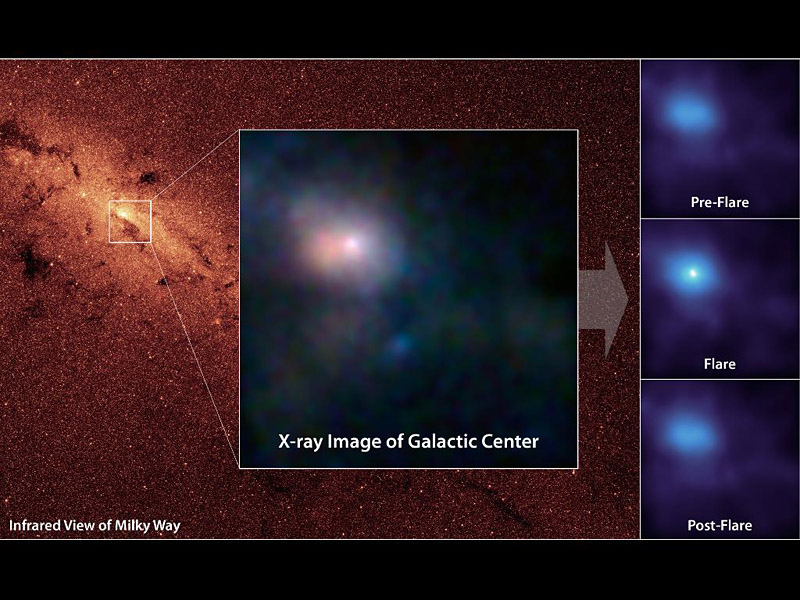
Compared to giant black holes at the centers of other galaxies, Sgr A* is relatively quiet. Active black holes tend to gobble up stars and other fuel around them. Sgr A* is thought only to nibble or not eat at all, a process that is not fully understood. When black holes consume fuel — whether a star, a gas cloud or, as recent Chandra observations have suggested, even an asteroid — they erupt with extra energy.
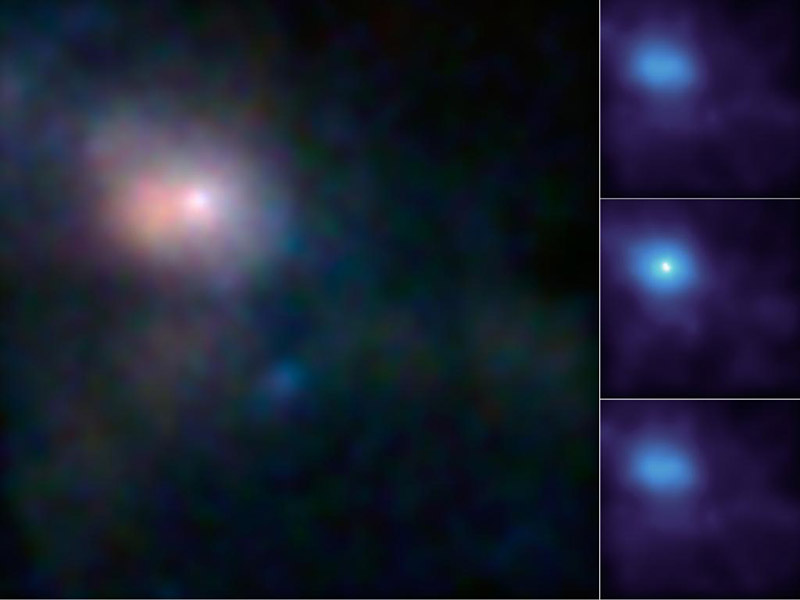
In the case of NuSTAR, its state-of-the-art telescope is picking up X-rays emitted by consumed matter being heated up to about 180 million degrees Fahrenheit (100 million degrees Celsius) and originating from regions where particles are boosted very close to the speed of light. Astronomers say these NuSTAR data, when combined with the simultaneous observations taken at other wavelengths, will help them better understand the physics of how black holes snack and grow in size.
NuSTAR is a Small Explorer mission led by Caltech and managed by NASA’s Jet Propulsion Laboratory in Pasadena for NASA’s Science Mission Directorate in Washington. Orbital Sciences Corporation of Dulles, VA, built the spacecraft. Its instrument was built by a consortium including Caltech; JPL; the University of California (UC) Berkeley; Columbia University; NASA’s Goddard Space Flight Center in Greenbelt, MD; the Danish Technical University in Denmark; Lawrence Livermore National Laboratory in Livermore, CA; and ATK Aerospace Systems of Goleta, CA.
NuSTAR’s mission operations center is at UC Berkeley, with the Italian Space Agency providing an equatorial ground station located at Malindi, Kenya. The mission’s outreach program is based at Sonoma State University in Rohnert Park, CA. Goddard manages NASA’s Explorer Program. Caltech manages JPL for NASA.
For information about NASA and agency programs, visit: http://www.nasa.gov .