

Written by Jia-Rui C. Cook and D.C. Agle
NASA’s Jet Propulsion Laboratory
 Pasadena, CA – In a preliminary analysis of images from NASA’s Dawn mission, scientists have spotted intriguing gullies that sculpt the walls of geologically young craters on the giant asteroid Vesta.
Led by Jennifer Scully, a Dawn team member at the University of California, Los Angeles, these scientists have found narrow channels of two types in images from Dawn’s framing camera – some that look like straight chutes and others that carve more sinuous trails and end in lobe-shaped deposits. The mystery, however, is what is creating them?
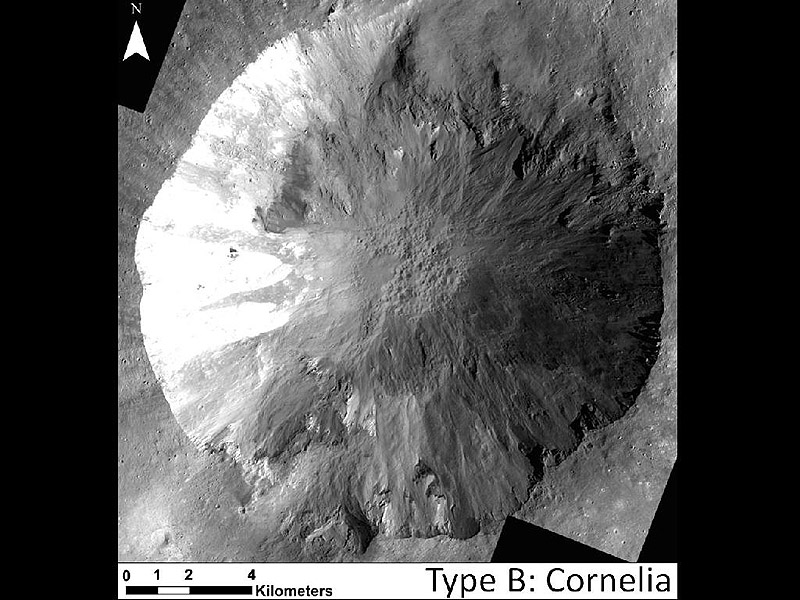
“The straight gullies we see on Vesta are textbook examples of flows of dry material, like sand, that we’ve seen on Earth’s moon and we expected to see on Vesta,” said Scully, who presented in-progress findings on these gullies today. “But these sinuous gullies are an exciting, unexpected find that we are still trying to understand.”
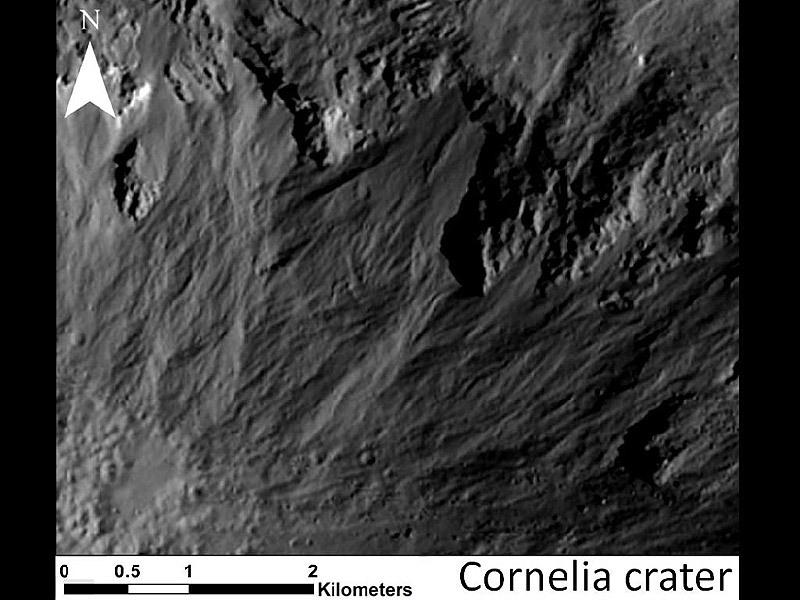 The sinuous gullies are longer, narrower, and curvier than the short, wide, straight gullies. They tend to start from V-shaped, collapsed regions described as “alcoves” and merge with other gullies. Scientists think different processes formed the two types of gullies and have been looking at images of Earth, Mars and other small bodies for clues.
“On Earth, similar features – seen at places like Meteor Crater in Arizona — are carved by liquid water,” said Christopher Russell, Dawn’s principal investigator, also based at UCLA. “On Mars, there is still a debate about what has caused them. We need to analyze the Vesta gullies very carefully before definitively specifying their source.”
JPL manages the Dawn mission for NASA’s Science Mission Directorate in Washington. Dawn is a project of the directorate’s Discovery Program, managed by NASA’s Marshall Space Flight Center in Huntsville, AL. The University of California at Los Angeles (UCLA) is responsible for overall Dawn mission science. Orbital Sciences Corp. in Dulles, VA, designed and built the spacecraft.
The German Aerospace Center, the Max Planck Institute for Solar System Research, the Italian Space Agency and the Italian National Astrophysical Institute are international partners on the mission team. The California Institute of Technology in Pasadena manages JPL for NASA.
For more information about Dawn, visit: http://www.nasa.gov/dawn and http://dawn.jpl.nasa.gov .