

Written by Jia-Rui C. Cook
NASA’s Jet Propulsion Laboratory
 Pasadena, CA – Following its last close flyby of Saturn’s moon Rhea, NASA’s Cassini spacecraft captured these raw, unprocessed images of the battered icy moon. They show an ancient, cratered surface bearing the scars of collisions with many space rocks.
Scientists are still trying to understand some of the curious features they see in these Rhea images, including a curving, narrow fracture or a graben, which is a block of ground lower than its surroundings and bordered by cliffs on either side.
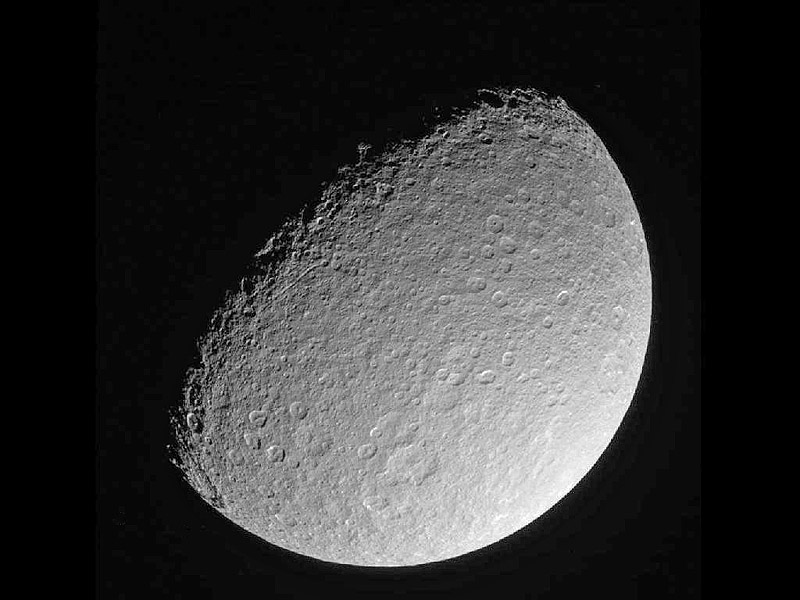
Cassini flew by Rhea at an altitude of 620 miles (997 kilometers) on March 9th, 2013. This flyby was designed primarily for the radio science sub-system to measure Rhea’s gravity field.
During closest approach and while the radio science sub-system was measuring the icy satellite’s gravity field, the imaging team rode along and captured 12 images of Rhea’s rough and icy surface. Outbound from Rhea, Cassini’s cameras captured a set of global images from a distance of about 167,000 miles (269,000 kilometers).
 Data from Cassini’s cosmic dust analyzer were also collected to try to detect any dusty debris flying off the surface from tiny meteoroid bombardments. These data will help scientists understand the rate at which “foreign” objects are raining into the Saturn system.
This was the mission’s fourth close encounter with Rhea. The spacecraft will pass the moon, but at a much greater distance, in a few years.
The Cassini-Huygens mission is a cooperative project of NASA, the European Space Agency and the Italian Space Agency. NASA’s Jet Propulsion Laboratory manages the mission for NASA’s Science Mission Directorate, Washington, D.C. JPL is a division of Caltech.
For more information on Cassini, visit http://www.nasa.gov/cassini and http://saturn.jpl.nasa.gov .