


 Clarksville, TN — On the morning of June 6th, 1944, a slab-sided gray ship steamed toward Omaha Beach with tanks in her belly and the largest seaborne invasion in history unfolding around her. Eighty-two years later, that same ship nosed into the Cumberland River at Clarksville on Wednesday, October 7th, 2026, under her own power.
USS LST-325 is back. She has outlasted a world war, Arctic ice, three decades in a foreign navy and an ocean crossing the U.S. Coast Guard advised against.
Clarksville is the final stop of her 2026 fall cruise, which brought her up the Cumberland River to Hendersonville and Ashland City. She is docked along the Clarksville Riverwalk at McGregor Park, just downriver from the McGregor Park Boat Ramp at 640 North Riverside Drive.
Tours begin Thursday, October 8th at 9:00am and run five days only, through Monday, October 12th. She departs Tuesday, October 13th, typically around 9:00am, for her home port in Evansville, Indiana.
A Secret Weapon Built for the Beach
The LST, short for Landing Ship, Tank, began as Winston Churchill’s problem. When the British Army was driven off the beaches at Dunkirk, it left its tanks and heavy equipment behind. Any return to Europe would have to come across open beaches, because Germany would mine and fortify every port.
Britain’s first landing ships failed because their V-shaped hulls dug into the sand. Churchill took the problem to President Franklin Roosevelt, and American designers answered with a flat-bottomed ship that could run straight onto a beach, open her bow doors and drive tanks ashore.
The United States built 1,051 of them, launching a new ship roughly every five days from yards in Evansville and Jeffersonville, Indiana; Seneca, Illinois; Pittsburgh; and elsewhere.
LST-325’s keel was laid at the Philadelphia Navy Yard on August 10th, 1942. She was launched just 48 days later, on October 27th, 1942, and commissioned on February 1st, 1943.
She is 328 feet long and 50 feet wide, and her bottom rises one foot for every 50, the slope of an average beach. On a landing run she drew only about three and a half feet of water at the bow.
As she approached the shore, her crew dropped a 3,000-pound sand anchor about 900 feet out. The anchor kept her straight in the surf, and once she was unloaded, the crew winched against it to pull her back off the beach.
D-Day and 43 Trips Across the Channel

LST-325 crossed the Atlantic in the first convoy of U.S. Navy LSTs to reach the European war zone. She landed troops and supplies at Sicily and Salerno, at one point carrying 20 Sherman tanks on her tank deck with Jeeps and artillery packed onto the deck above.
She arrived off Omaha Beach with the invasion fleet, and on June 7th her first load of 59 vehicles, 31 officers and 408 enlisted men went ashore by barge and smaller landing craft. Three doctors were aboard to operate on the most badly wounded, and she carried 38 casualties back to England. On June 12th, she made her first full beach landing at Utah Beach.
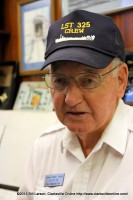
“I don’t think we would’ve succeeded with the Normandy invasion without the LSTs,” former Captain Robert D. Jornlin said during the ship’s 2012 visit to Clarksville.
From June 1944 through April 1945, she made 43 trips across the English Channel, hauling ammunition, fuel, food and anything else the Allied armies needed to Omaha, Utah, Gold and Juno beaches.
LST-325 earned two battle stars for her World War II service.
From the Arctic to the Aegean
The end of the war did not end her career. In the 1950s she was fitted with a reinforced bow for work in ice and sent north as USNS T-LST-325. She worked the Labrador Sea, Davis Strait and Baffin Bay, supplying crews building radar stations along the coasts of Canada and Greenland.
In 1964 the United States transferred her to Greece. The Hellenic Navy renamed her RHS Syros (L-144) and kept her in service for more than three decades.
The Voyage Home
By the 1990s, not a single World War II LST remained in the United States for veterans to visit. Members of the U.S. LST Association began searching abroad. When Greece announced plans to retire its aging LSTs, the veterans asked for one. The Greek government agreed, and in 2000 the USS LST Ship Memorial took possession of Syros on the island of Crete.
She was in far worse shape than promised. While the transfer stalled, parts had continued to be stripped from her. A volunteer crew of World War II and Korean War veterans spent about three and a half months in the Mediterranean heat making her seaworthy.
The veterans paid their own way. Each man put up $2,100 toward airfare, food and fuel, and British Petroleum donated 50,000 gallons of fuel for the crossing.
Many volunteers dropped out during the long delays and the heat. The final crew numbered 28 veterans and one photographer.
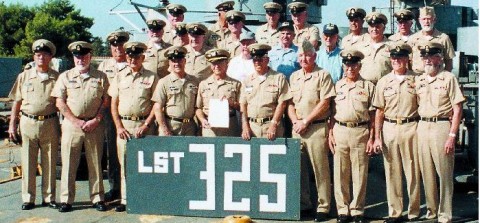
The Coast Guard formally recommended against the voyage, citing the ship’s lifesaving equipment and her lack of an emergency generator. The crew sailed from Crete anyway on November 14th, 2000.
Nearly everything that could go wrong did. Soon after leaving Athens, a cracked manifold knocked out one engine, and the steering and a gyrocompass failed. The Mediterranean crossing took 13 days instead of nine.
After 12 days of repairs at Gibraltar, an injector failed about 1,000 miles into the Atlantic and burned out a cylinder. The crew shut that cylinder down and ran the engine on the remaining 11 for the next 3,000 miles, into headwinds the entire way.
They reached Mobile, Alabama on January 10th, 2001, right on schedule, after a 5,000-mile voyage. Thousands of people crowded the waterfront to greet them. Local newspapers and television stations had tracked their progress for weeks.
Captain Jornlin, who commanded the ship on that voyage, tells the full story in his book Bringing Back a Hero, available in the ship’s gift shop.
A New Captain on the Bridge

LST-325 comes to Clarksville this year under a new commanding officer. Captain John Vaughn of Galena, Illinois took command on January 10th, 2026, 25 years to the day after the veteran crew brought her into Mobile. A formal Change of Command ceremony in the Navy tradition followed on May 2nd.
Vaughn is the third captain since the ship came home from Greece. He succeeds Captain Bob Kabota, who stepped down to spend more time with his family and recommended Vaughn for the job.
Vaughn has worked the river since childhood and still captains Marquette Transportation’s towboat Theresa Wood on the Mississippi full-time.
He first came aboard LST-325 about ten years ago, when the crew needed a pilot who knew the lower Mississippi to take her to Vicksburg. He told the Galena Gazette he signed on mostly out of curiosity, having never seen a ship on the Mississippi. He made three more trips with the crew after that first one.
As captain, Vaughn plans each cruise, coordinates with the Coast Guard and local authorities, and looks after the more than 50 volunteers who sail with him, roughly half the 110 sailors who crewed her in wartime.
The volunteers are organized into deck and engineering divisions, and each must log 80 hours a year to qualify. During maintenance work weeks, they live aboard the ship.
Between cruises she stays at her home port in Evansville, where she is open for tours year-round. Each fall she sets out on a fundraising cruise to river towns like Clarksville.
Vaughn says handling her on the river is much like running a small towboat, only taller. People on the riverbank still stop to wave as she passes.
She is the last World War II LST in her original wartime configuration and the only one still able to sail. The others survive as static displays.
“I don’t think they ever thought that this ship would still be running 84 years later,” Vaughn said.
Tour Information

LST-325 is open daily from 9:00am to 5:00pm, Thursday, October 8th through Monday, October 12th. The final tour group departs at 5:00pm.
Admission is $20.00 for adults and $10.00 for children ages 6 to 17. Children 5 and under are admitted free.
Visitors board the way troops and tanks once left her, through her open bow doors and up the ramp into the tank deck. The tank deck and upper deck feature static displays and are self-guided, with volunteer docents on hand to explain what visitors are seeing.
The ship has steep ladders and stairs, so wear flat, sturdy shoes.
School groups can arrange visits by email at schoolbookings@LSTMemorial.org.
For more information, visit www.lstmemorial.org or the USS LST 325 Ship Memorial page on Facebook.
McGregor Park Boat Ramp Closed
The McGregor Park Boat Ramp is closed until LST-325 departs on Tuesday, October 13th. Boaters needing river access should use the Liberty Park Boat Ramp.
You can see her off

The crew typically gets under way around 9:00am, after breakfast, so Tuesday morning offers a rare chance to watch a World War II landing ship back off the bank and head down the Cumberland.
Good vantage points include the McGregor Park (640 North Riverside Drive) and Trice’s Landing (99 Oak Street)
Follow Her voyage Home
LST-325 broadcasts her position on the marine AIS network. Readers can follow her trip home to Evansville on VesselFinder or MarineTraffic by searching for MMSI 368463320.