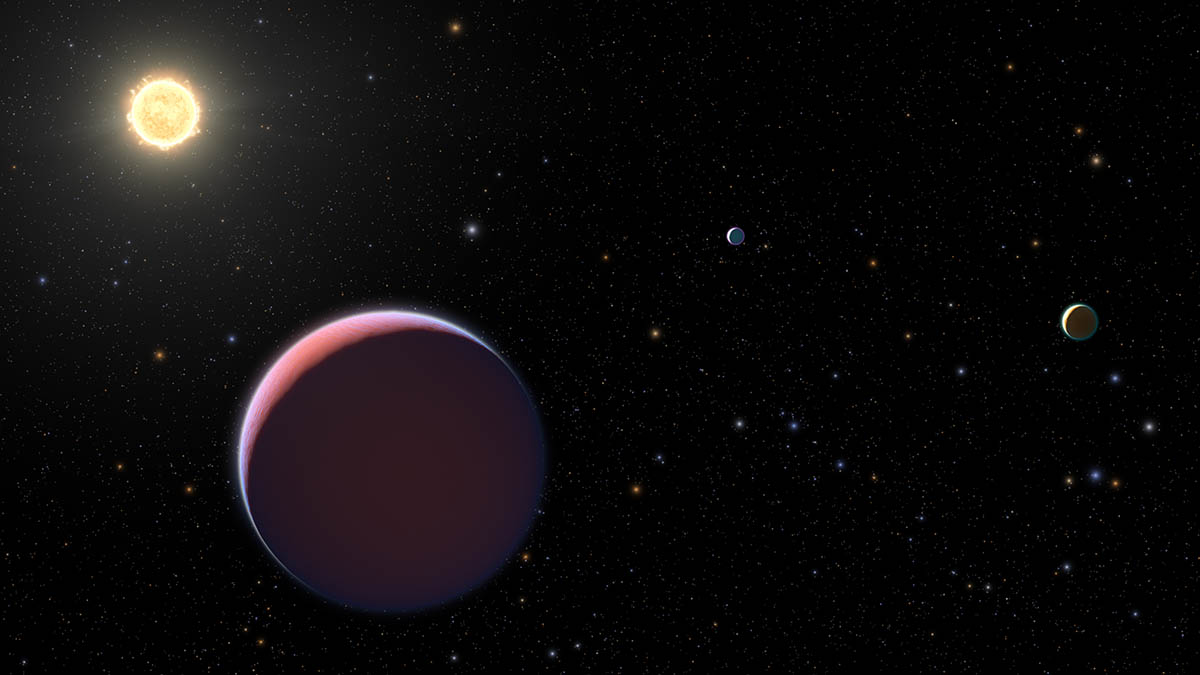
This illustration depicts the Sun-like star Kepler 51 and three giant planets that NASA’s Kepler space telescope discovered in 2012–2014. These planets are all roughly the size of Jupiter but a tiny fraction of its mass. This means the planets have an extraordinarily low density, more like that of Styrofoam rather than rock or water, based on new Hubble Space Telescope observations. (NASA, ESA, and L. Hustak, J. Olmsted, D. Player and F. Summers (STScI))
Home This illustration depicts the Sun-like star Kepler 51 and three giant planets that NASA’s Kepler space telescope discovered in 2012–2014. These planets are all roughly the size of Jupiter but a tiny fraction of its mass. This means the planets have an extraordinarily low density, more like that of Styrofoam rather than rock or water, based on new Hubble Space Telescope observations. (NASA, ESA, and L. Hustak, J. Olmsted, D. Player and F. Summers (STScI)) This illustration depicts the Sun-like star Kepler 51 and three giant planets that NASA's Kepler space telescope discovered in 2012–2014. These planets are all roughly the size of Jupiter but a tiny fraction of its mass. This means the planets have an extraordinarily low density, more like that of Styrofoam rather than rock or water, based on new Hubble Space Telescope observations. (NASA, ESA, and L. Hustak, J. Olmsted, D. Player and F. Summers (STScI))
This illustration depicts the Sun-like star Kepler 51 and three giant planets that NASA’s Kepler space telescope discovered in 2012–2014. These planets are all roughly the size of Jupiter but a tiny fraction of its mass. This means the planets have an extraordinarily low density, more like that of Styrofoam rather than rock or water, based on new Hubble Space Telescope observations. (NASA, ESA, and L. Hustak, J. Olmsted, D. Player and F. Summers (STScI))