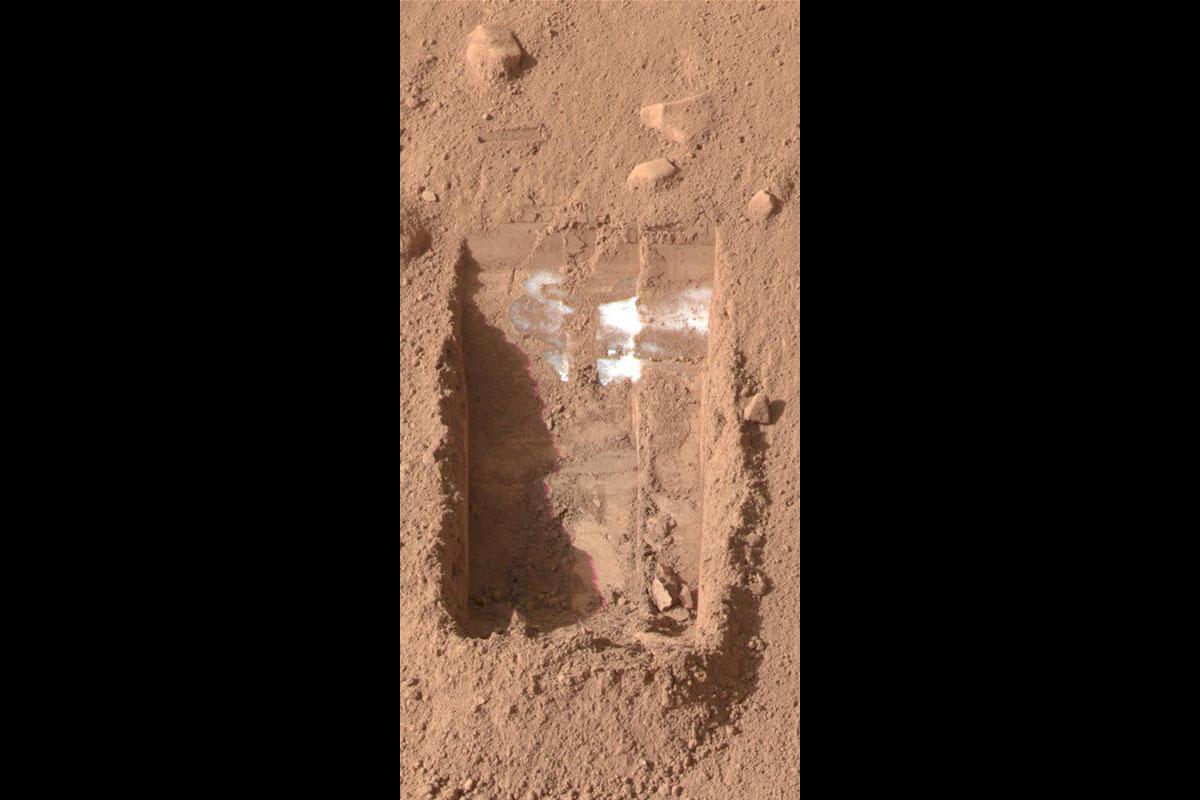
NASA’s Phoenix Mars Lander shows the trench, called ‘Dodo-Goldilocks,’ lacking lumps of ice seen previously. The ice had sublimated, a process similar to evaporation, over the course of four days. (NASA/JPL-Caltech/University of Arizona/Texas A&M University)
Home NASA’s Phoenix Mars Lander shows the trench, called ‘Dodo-Goldilocks,’ lacking lumps of ice seen previously. The ice had sublimated, a process similar to evaporation, over the course of four days. (NASA/JPL-Caltech/University of Arizona/Texas A&M University) NASA's Phoenix Mars Lander shows the trench, called 'Dodo-Goldilocks,' lacking lumps of ice seen previously. The ice had sublimated, a process similar to evaporation, over the course of four days. (NASA/JPL-Caltech/University of Arizona/Texas A&M University)
NASA’s Phoenix Mars Lander shows the trench, called ‘Dodo-Goldilocks,’ lacking lumps of ice seen previously. The ice had sublimated, a process similar to evaporation, over the course of four days. (NASA/JPL-Caltech/University of Arizona/Texas A&M University)