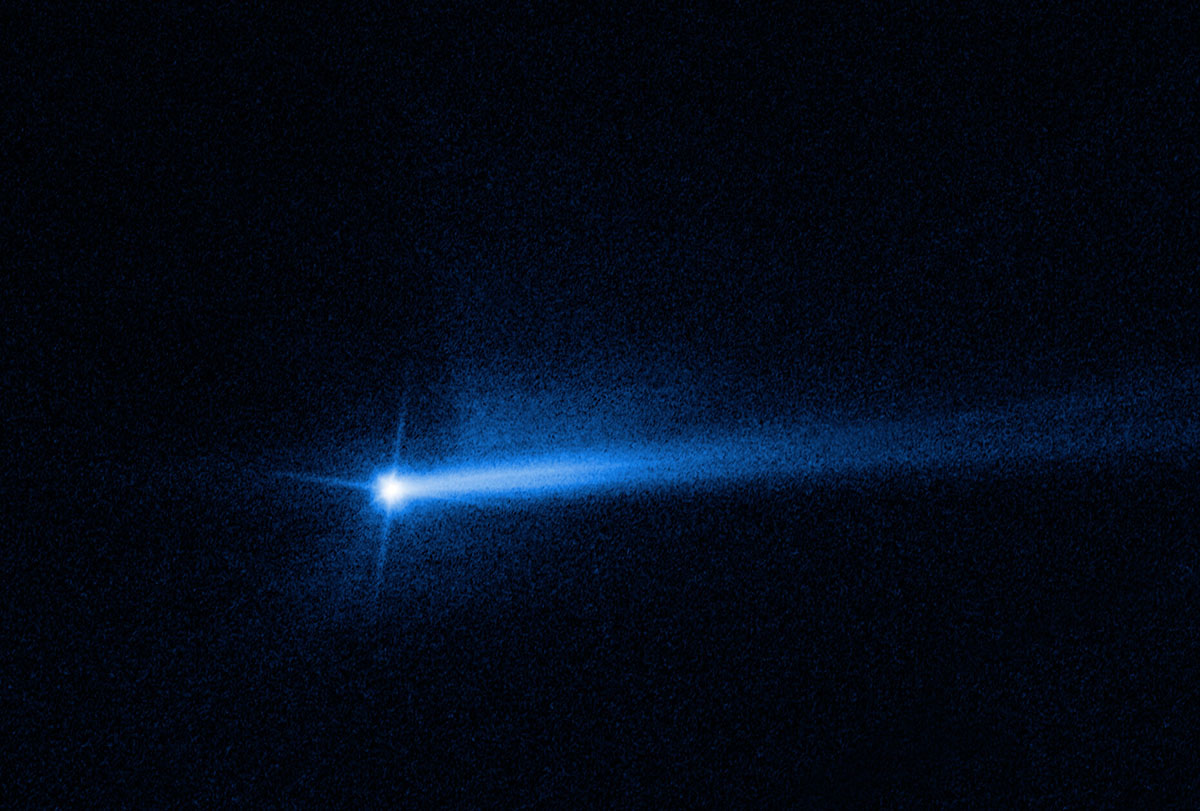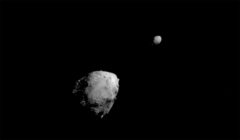
The Hubble Space Telescope observed two tails of dust ejected from the Didymos-Dimorphos asteroid system several days after NASA’s DART spacecraft impacted the smaller asteroid. (NASA, ESA, Jian-Yang Li (PSI), Joe Depasquale (STScI))
Home The Hubble Space Telescope observed two tails of dust ejected from the Didymos-Dimorphos asteroid system several days after NASA’s DART spacecraft impacted the smaller asteroid. (NASA, ESA, Jian-Yang Li (PSI), Joe Depasquale (STScI)) The Hubble Space Telescope observed two tails of dust ejected from the Didymos-Dimorphos asteroid system several days after NASA’s DART spacecraft impacted the smaller asteroid. (NASA, ESA, Jian-Yang Li (PSI), Joe Depasquale (STScI))
The Hubble Space Telescope observed two tails of dust ejected from the Didymos-Dimorphos asteroid system several days after NASA’s DART spacecraft impacted the smaller asteroid. (NASA, ESA, Jian-Yang Li (PSI), Joe Depasquale (STScI))