

 Clarksville, TN – On the third floor of the Sundquist Science Center, a group of enterprising Austin Peay State University (APSU) students are pushing the boundaries of virtual reality, one molecule at a time.
The pioneering project to create a 3D library of chemical compounds began as an offshoot of STEM Scholars – a program run by Drs. Anuradha Pathiranage and Mike Wilson – that gets aspiring researchers into the lab and working on projects from day one.
Armed with a CoSTEM Innovative Teaching Mini-grant, the VR endeavor has evolved into its own independent study course, uniting three professors — Drs. Pathiranage (APSU Department of Chemistry), Cody Covington (Department of Chemistry), and Saeed Samadi-Dana (APSU Department of Computer Science) – in the pursuit of advancing VR technology within the APSU College of STEM.
“Chemistry is a complex subject,” Pathiranage said. “We are looking at structures all the time, but usually in 2D. When students see the 3D structures, especially protein molecules and larger structures, they can understand the concept better. We have a lot of goals in the future; we are planning to do a library of compounds.”
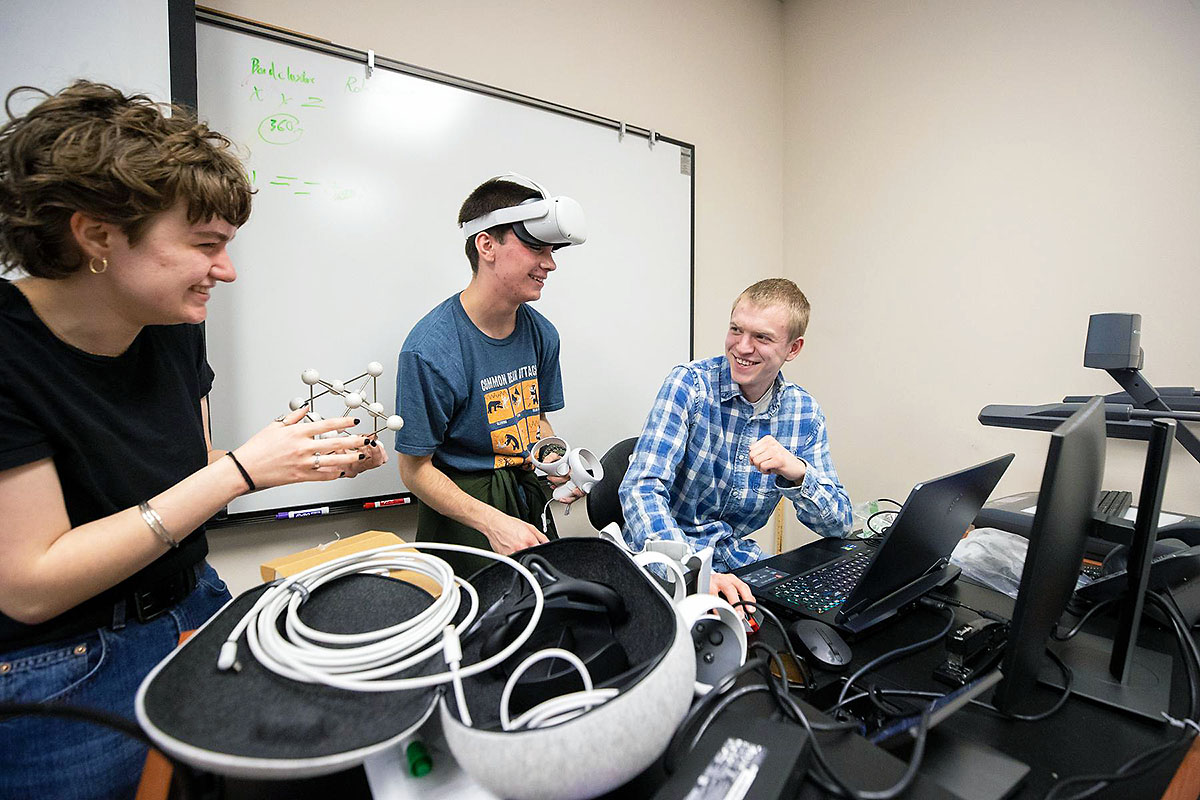
At the heart of this groundbreaking work is a dedicated team of students, each bringing their unique expertise to the virtual table. Owen Fink, Kaleb Scott and Peggy Lewis, all computer science majors, tackle the intricate world of programming and coding.
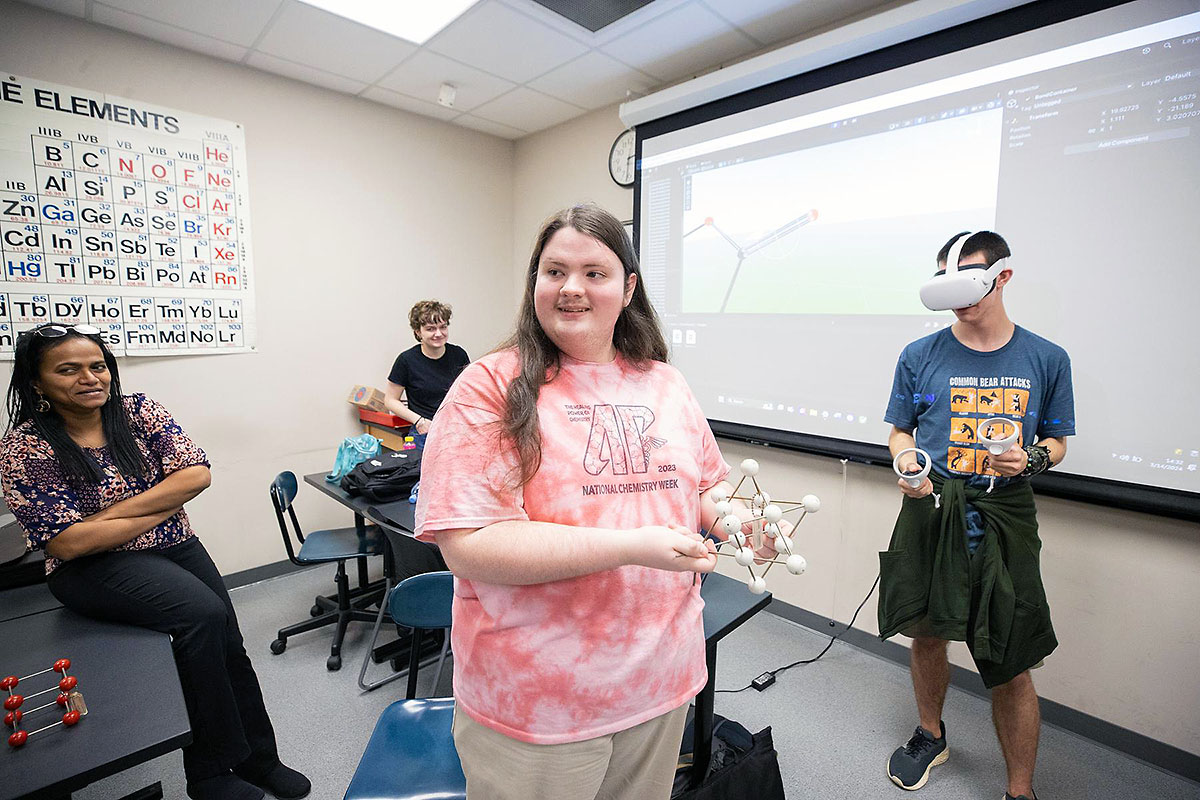
Calleway Schmidt, an engineering physics student, meticulously documents the project’s progress and will later run a graphic design team. Ashton Cromwell, a chemistry major, fields all chemistry-related inquiries, ensuring the scientific accuracy of their virtual creations.
“What I’m doing looks complicated, but it’s really not,” Fink said, gesturing to a complex diagram sprawled across a whiteboard. “Our program consists of three main factors: user interface, displaying data, and gathering information. Our end goal is mass spectrum, which is part of the interface, but before we can tackle that, we have to have a functional base.”
The team’s collaborative spirit is evident as they navigate the intricacies of each other’s fields of study.
“It’s a crash course in everyone else’s discipline,” Scott said. “We can resolve almost anything through communication, whether it’s explaining from our computer science perspective what we’re capable of doing or understanding what kind of features they want us to implement from a chemistry standpoint.”
The VR project’s potential applications range from enhancing undergraduate chemistry education to facilitating advanced research in professional labs.