

Written by Christie Crawford
 Clarksville, TN – The Olympic rings have come down from the Eiffel Tower, the banners have come off the banks of the Seine, and the news buzz has faded about the water dominance of Léon Marchand. It was the perfect time to visit France. Most travelers would tell you that if you hit the sights of Paris, then you’re one and done. But that couldn’t be further from the truth.
France is as varied as the United States. Regions vary in topography, culture, and food traditions. In our three weeks of touring France, mainly the countryside plus Paris, my husband and I fell in love with the differences, and it whet our appetite to both visit the areas we could not visit due to time constraints, and revisit the little known places that really caught our eye. It’s been a year since we were there, and I thought I might describe one of these French travel jewels.

Chances are, when asked to name a region in France, the Dordogne region is not on the tip of your tongue. But you might know it from the history of Eleanor of Aquitaine, the setting for Michael Crichton’s Timeline, and the movie Chocolat. Nestled below the stunning chateau and wine region of the Loire Valley and just northwest of the artistic and photogenic Provence region, lies the Dordogne locale.
What makes it so captivating is that it consists of dense forestland, meandering rivers, and many hilltop villages known as perchés. Medieval time reigns supreme here with castles both English and French on the side of its majestic Dordogne River, known to be the cleanest of all France, mainly due to the lack of industry residing there. It also has the highness density of old buildings in all of France.
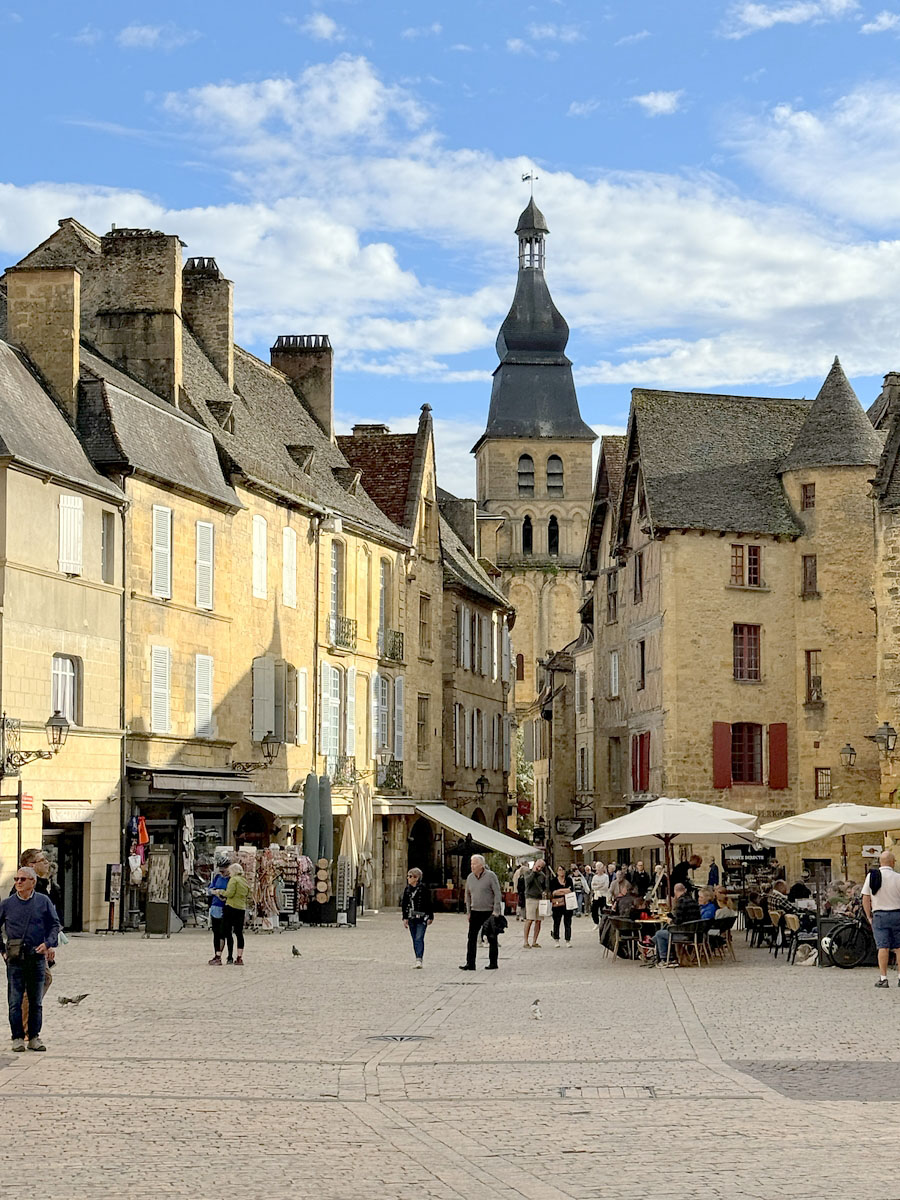
Still known by its ancient name Perigord, it has existed as a favorite get-away retreat for French, English and Dutch residents. The star town of the region is Sarlat-la-Canéda with its most famous farmers market, including an indoor covered church section, 15th century medieval architecture featuring ochre colored stone townhomes with limestone roofs, and its reputation as being the place of origin for foie gras or duck/goose liver pate.

There is even a Square of the Geese in town commemorating the famous and quintessential French food. Driving through its countryside you are surrounded by fields of radishes and chard, and nut orchards amid the remains of sunflowers in their dark drab state, awaiting their transformation into sunflower oil.
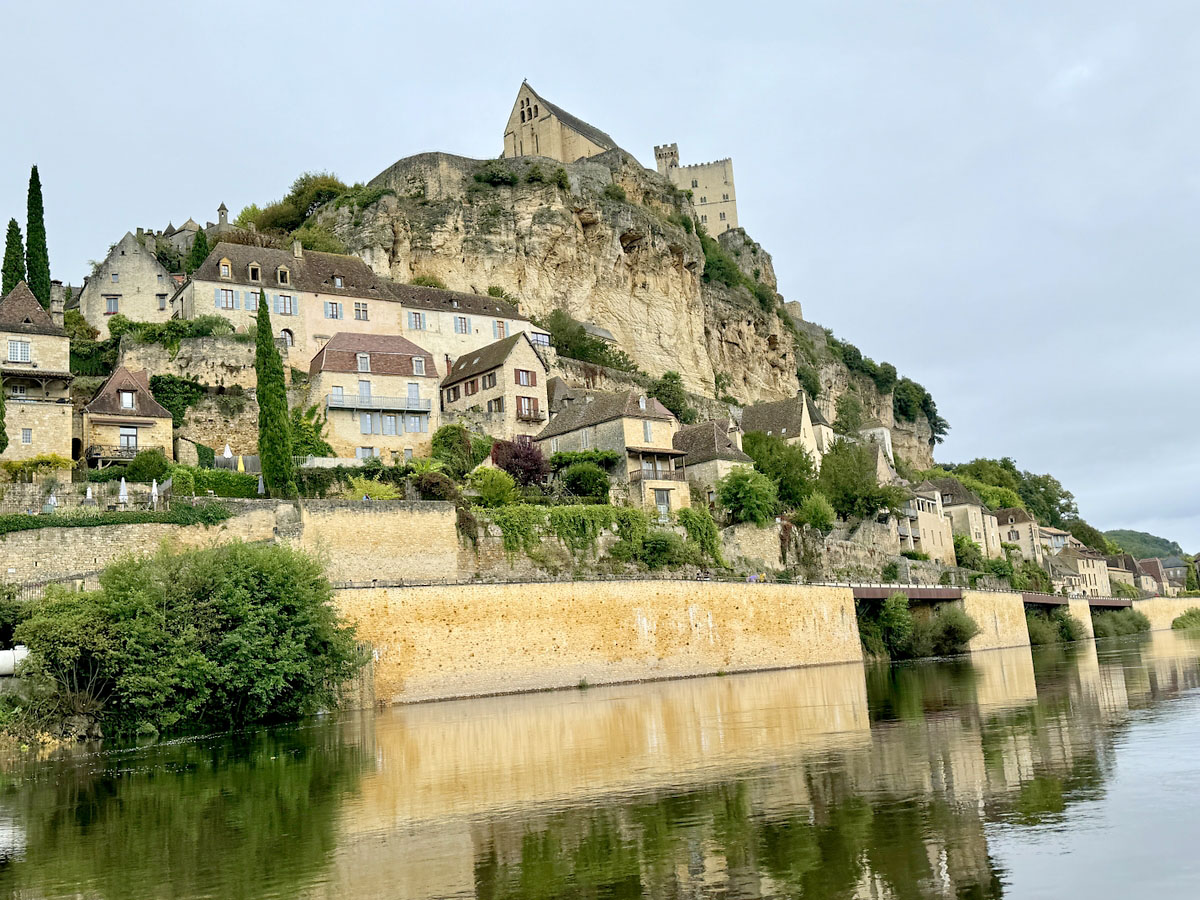
Next stop was in Beynac which lies at the base of the Dordogne river with the Chateau Beynac atop and its village scenes seen in the movie Chocolat. Walking the streets you can see the perigordine style of homes with stone walls, steep pitch roofs and wooden shutters. The 12th century castle where Eleanor of Aquitaine, the only Queen of both England and France, and her son Richard the Lionhearted ,resided.
The north side of the river is occupied by French controlled chateaus, while English castles rest on the southern banks. This was the central core for the Hundred Years War from 1337 until the mid 15th century where France and England fought, off and on, in medieval times.
La-Roque-Gageac,is a must visit where you can see a riverside village with an immense cliff-side and a troglodyte fort, where cave dwellings served as complete homes. I would highly recommend you see Beynac or La-Roque-Gageac from a gabarre.
The flat bottom wooden boats are replicas, based on the original 19th century transportation for goods and supplies, such as vineyard stakes or boards for wine casks in this area. The tours lazily go up and down the Dordogne and give excellent views of various chateaus, including French Marqueyssac, English Castelnaud, and Fayrac.
Climb the 233 steps leading up to the famous church of Saint Amadour, where the shrine of Black Madonna resides – part of the Saint James pilgrimage, and you’ll find yourself in the cliff-side town of Rocamadour. There is an elevator to help ease your trip but even walking from the parking area up to town is a bit of an incline.

To drive there you travel thought the Route de La Noix (or route of the nut). This is walnut area and you will find traditional walnut bread for breakfast and even walnuts in a bowl available to crack.
Walnut oil is a specialty, and there are many flavors to try with varied uses in cooking. The town has many cheeses to savor, and there are goat farms aplenty in the countryside.
This is rural France at its best. With its picturesque towns, charming chateaus, rich culinary tradition and historical significance, the Dordogne is a place that will take you back to old France.
It’s no wonder that Alexandre Dumas re-imagined the Dordogne as his basis for The Three Musketeers.