

Written by D.C. Thomas
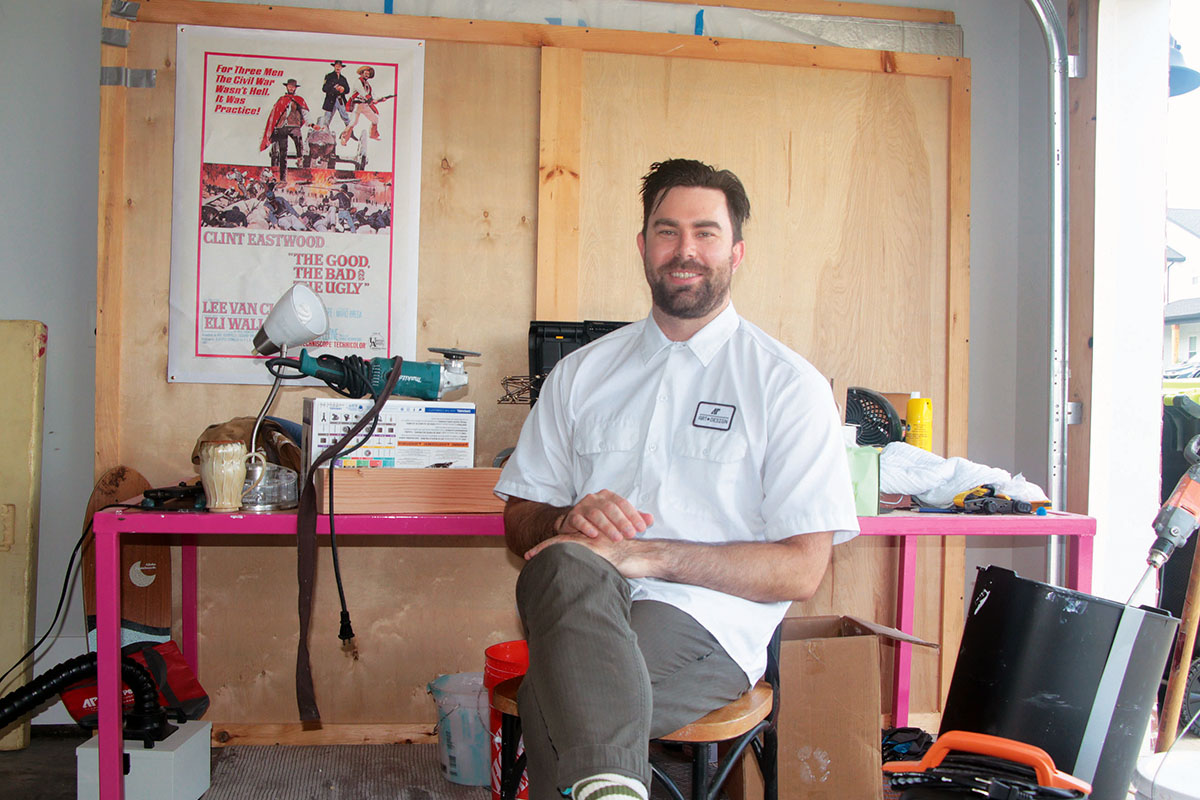
 Clarksville, TN – During an interview with Professor Luke Warren, I again understood how well art and communication intersect. As a student of communication at Austin Peay State University, I am always looking for ways to understand how ideas move between people and communities.
This conversation, part of a larger multimedia project on Clarksville’s artistic community, offered that opportunity in abundance. Warren, assistant professor of sculpture at APSU, is an artist and educator who sees no division between the two. “I think of my teaching as my art practice and I think of my art practice as my teaching. That’s really, really important for me”.
His career path reflects this merging of roles. Born in Southern California, he studied film, television, and digital media at Texas Christian University before earning his MFA in sculpture from Cranbrook Academy of Art.
He taught in Connecticut and Colorado before arriving in Clarksville, where he found a home and a stage for his ideas. “I absolutely love it here,” Warren said about Clarksville.
Film, music, and sculpture converge in his work, creating layers of meaning that ask more questions than they answer. He describes his artistic identity with a term he coined: “contextician.”

And so, for Warren, every detail of a piece, such as the material, its placement in the gallery, and its relationship to other works, contributes to a broader dialogue. “Everything has to be ultra-considered, because it’s all up for grabs.”
His aim is not simply to craft objects, but to design experiences that spark conversation. Warren’s practice extends well beyond the walls of his studio. At APSU, he has been instrumental in reviving the university’s public sculpture program.
Earlier in March, he facilitated the installation of Cracked Earth by sculptor Araan Schmidt, the first outdoor public sculpture on campus since 2018. As he noted, such works enrich the university and the wider community, helping to create what he calls a “cultural language of sculpture for Clarksville.”
This language is developing on multiple fronts.
Warren serves on the Tennessee Trail Arts Commission and has contributed to projects at the Customs House Museum & Cultural Center. He is also part of a committee working to preserve the legacy of Montgomery County folk sculptor E.T. Wickham, and make it more accessible to the public at RichEllen Park.
Wickham, who began creating life-sized concrete statues in his late sixties, left behind a unique body of work honoring local and national figures.
By engaging Wickham’s legacy alongside contemporary projects, Warren emphasizes that public art in Clarksville is rooted in heritage and oriented towards the future.
“Public sculptures are freely accessible. You don’t have to pay to go into a museum, you don’t have to have membership anywhere, you don’t have to spend any funds. You can just walk along the trail and come upon these important, interesting sculptural artifacts that hopefully will generate conversation.”
This belief resonates with what Americans for the Arts (Public Art Network Council’s Green Paper Why Public Art Matters) published: “Public art is a distinguishing part of our public history and our evolving culture. It reflects and reveals our society, adds meaning to our cities, and uniqueness to our communities.”
For Warren, art is never detached from larger questions. “For me, the concept is everything. I am much more interested in that, because that, to me, is the way my work operates in the most profound way.”
Drawing from film, organized sports, religion, or social experience, his work always situates itself in dialogue with cultural systems. At the same time, he encourages students and artists to consider that engagement with ideas gives art its power to endure. “I try to encourage folks to just engage a larger idea, whatever that may be … it doesn’t have to be this heady, intellectual thing, but it needs to be about something other than itself.”
During such conversations, one becomes more aware of the communicative power of art: that meaning is never contained in a single object, but emerges in the exchange between creator, work, and audience.
Warren embodies that principle not only in his teaching but in his public engagement practice: “My job as an artist, as an educator, is to continue to make art and to continue to educate,” he said.In Clarksville, his work and practices are shaping spaces and conversations.
From Wickham’s sculptures to the installation of contemporary works on campus, the city’s cultural identity is being sculpted, quite literally, in real time.
And in the process, students like me, thanks to professors such as Warren, are discovering that art is not just something to observe, but a language through which communities speak, remember, and work together.