
 Clarksville, TN — The last long, slow mornings of summer are running out. Sometime this weekend, a lot of Clarksville parents will look up from the pool, the backyard, or the grocery list and realize the same thing at once: School starts on Wednesday.
Clarksville-Montgomery County students head back on Wednesday, August 5th — a half day to ease everyone in. The first full day follows on Monday, Augugst 10th. Between now and then, the district’s roughly 40,000 students and their families have a short, busy runway, and a little planning this weekend will make Wednesday morning feel a lot less like a fire drill.
Spend wisely on School Supplies
Getting ready by attending the open house
Before you buy a single glue stick, get your child into the building. CMCSS schools are holding back-to-school open houses this week, and they’re the fastest way to trade uncertainty for a plan. Middle schools open their doors Monday, August 3rd, from 5:00pm to 7:00pm , elementary schools Tuesday, August 4th, 5:00pm to 7:00pm, and high schools Wednesday, August 6th, 5:00pm to 7:00pm.
For a nervous kindergartner or a student walking into a new building, meeting the teacher and finding the classroom, the cafeteria, and the bathroom ahead of time does more for first-day nerves than any pep talk. It’s also where you’ll get the details that never quite make it onto a website — the drop-off door, the dismissal routine, the teacher’s specific supply preferences.
Chase down the right supply list
Here’s the part parents get wrong every year: there is no single master list. The CMCSS general supply list is a solid starting point, but the list that actually matters is your child’s, from your child’s teacher, at your child’s school.
Before you shop, check your school’s Facebook page and your ParentSquare messages first — that’s where grade-specific and teacher-specific lists tend to land. If you want the district’s general guide, it’s posted at cmcss.net. The pattern, by level, looks like this:
Elementary is a world of consumables: dozens of No. 2 pencils (no mechanical for the little ones), crayons, glue sticks, blunt scissors, wide-ruled composition notebooks, folders, and a plastic supply box. Skinny dry-erase markers show up on nearly every list now, too.
Middle school shifts toward organization: pencils and colored pencils, notebook paper, highlighters, a soft pencil pouch, three-ring binders that vary by subject, and one item that surprises first-timers — wired earbuds or headphones (not wireless), used constantly for testing and classwork. A TI-30XIIS calculator is recommended but optional.
High school adds a planner, index cards, pens in black, blue, and red, and, for math, graph paper and — depending on the campus — a graphing calculator like the TI-84 (though schools provide access, so hold off on that $100.00 purchase until a teacher says it’s required).
One tip that saves money and headaches: buy the backpack and the pencil pouch now, but wait on the specialized or expensive items until after open house. Teachers routinely trim or swap what’s on the printed list.
Send a little extra — the classroom runs on it
Look closely at those elementary lists and you’ll notice something. The two boxes of tissues, the disinfecting wipes, the hand sanitizer, the extra glue sticks and dry-erase markers — those aren’t really for your child alone. As the district’s own list notes, supplies are collected and stored for the whole classroom. In practice, the community chest of consumables is what keeps a room of 22 kids running from August to May.
Those are exactly the things classrooms burn through fastest and teachers most often end up buying out of their own pockets: tissues, Clorox and disinfecting wipes, hand sanitizer, glue sticks, dry-erase markers, gallon and sandwich zip bags, cardstock, and copy paper. If your budget has any give in it after your own child is outfitted, an extra box of tissues or a pack of wipes tossed in the cart is one of the highest-impact five dollars you’ll spend all year. Ask the teacher at open house what the room is short on — most will tell you honestly, and gratefully.
Get the household ready, not just the backpack
The supplies are the visible part. The invisible part is the reset.
Bedtimes and wake-ups don’t fix themselves overnight, so start sliding them earlier now rather than shocking everyone awake at 6 a.m. on Wednesday. Lay out first-day clothes and pack the bag Tuesday night. Confirm the plan your child can actually recite: how they get to school, how they get home, and who’s there when they arrive.
Handle the paperwork this weekend while you’re thinking about it. Free and reduced-price meal applications for 2026-27 are open now — a new school year means a new application, even for returning families, and it’s worth completing if there’s any chance you qualify. Confirm your ParentSquare notifications are on so those teacher messages don’t slip past you.
Then there’s the drive
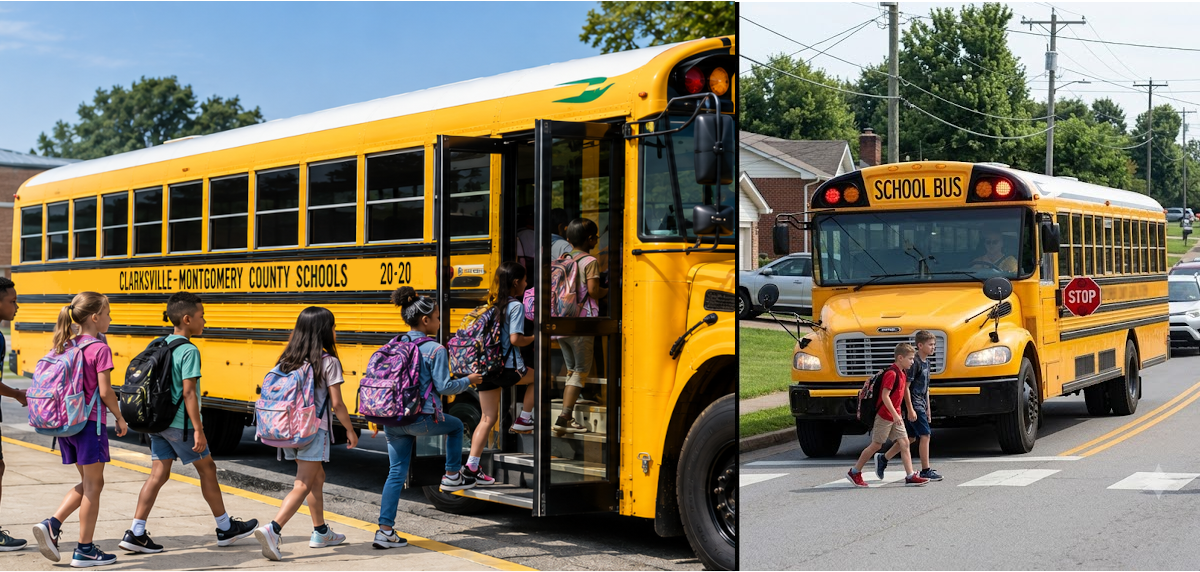
The single biggest change Wednesday morning isn’t in the classroom — it’s on the road. Overnight, thousands of children reappear at bus stops, crosswalks, and the edges of neighborhood streets, and every route you drive gets slower and more crowded. Clarksville Police are asking drivers to build in extra time and extra attention.
The basics carry the most weight: slow down, put the phone down, obey school-zone signs and flashing lights, and follow crossing guards and officers. Many students walk or bike, so watch the shoulders and the crosswalks, not just the car ahead of you. If you see children along the side of the road, ease off the gas — kids are unpredictable, and a few seconds of caution may save someone life.
The rule people most often get wrong is the school bus. Under Tennessee law, all traffic must stop when a bus has its red lights flashing and its stop arm out — including on multilane roads without a physical median, like Tiny Town Road. Police are pointed about this one: those roads aren’t treated as separate roadways, so traffic in *both* directions has to stop. The lone exception is a divided highway with a real median, where oncoming traffic may proceed with caution. When in doubt, stop.
Clarksville Police put it plainly: “A few extra moments of patience can help prevent a tragedy.”
That morning
On the first day, remember you don’t need a perfect first day. You need a backpack that’s packed, a kid who knows the plan, a teacher who has what the room needs, and a drive to school where everyone slows down and pays attention. Handle those four things this weekend, and Wednesday morning takes care of itself.
Welcome back to school, Clarksville. See you at the bus stop!