


 Clarksville, TN – If you have ever waved off online safety advice with the thought that you are not rich enough, famous enough, or important enough to be worth a hacker’s time, you are in good company. It is one of the most common reasons people skip the basics.
It is also one of the most dangerous, because it rests on a misunderstanding of how online crime actually works. Almost no one is hacked because a criminal singled them out by name. People are hacked because they were reachable and unprotected, and a machine somewhere noticed.
Understanding that one fact changes how everything else in this series will land, so it is the right place to begin.
You Are a Target Because You Are Connected, Not Because You Are Important
 Most attacks are not personal, and they are not aimed at you specifically. They are automated. Programs sweep across millions of computers and devices around the clock, looking for any that are easy to get into. Picture a burglar walking down a long street, quietly trying every door handle — not because he knows who lives where, but because he is looking for the one door someone forgot to lock.
The internet is that street, scaled up to the entire planet, and the trying of handles never stops. You do not have to be singled out to be caught. You only have to be the unlocked door the program happened to reach.
What Criminals Actually Want From an Ordinary Person
Here is the part that surprises people: a criminal often does not want your secrets at all. There are several things an everyday person has that are worth money to the right buyer, and most of them have nothing to do with being wealthy or important.
They may want your computer itself — its processing power and its internet connection, put to work on jobs you never agreed to. They may want your email and social media accounts, not for anything in them, but to send convincing scams to your friends and family, who will trust a message that appears to come from you.
They may want a foothold, a small first step that gets them closer to your bank or your identity. And sometimes they simply want a place to hide, routing their activity through your innocent-looking connection so that it cannot be traced back to them. A person with “nothing worth stealing” still has every one of these.
What Is a Botnet?
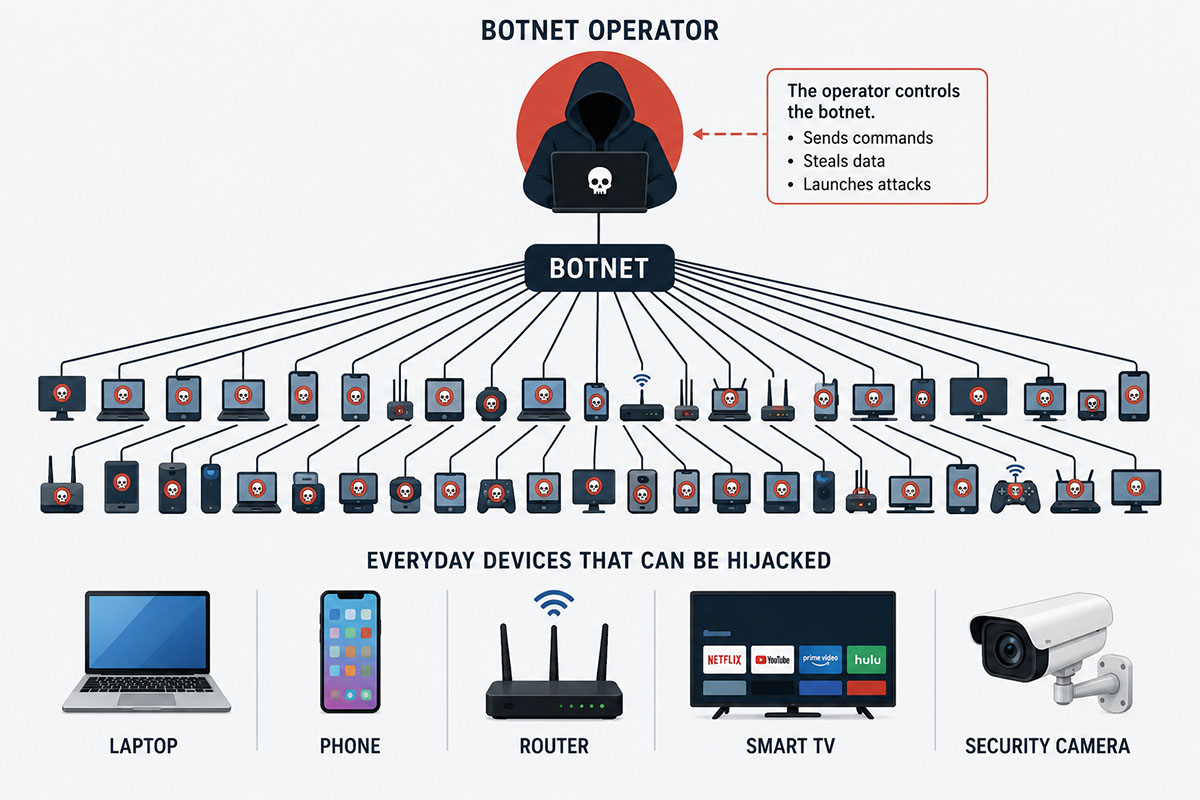 The clearest example of a criminal wanting your machine rather than your secrets is something called a botnet, and it is worth understanding in plain terms.
A botnet is a large collection of ordinary computers and devices that have been quietly taken over and are controlled, all at once, by a single operator somewhere else — usually without any of the owners having the faintest idea. Your computer goes about its day looking and feeling completely normal while, in the background, it follows orders from a stranger.
Now multiply that by hundreds of thousands of machines. That combined army can be pointed at almost anything: flooding a website with so much traffic that it collapses, blasting out millions of spam and scam emails, generating cryptocurrency, or helping break into far bigger targets. You pay the electric bill and the internet bill; the operator collects the profit.
And it is not only computers. Home internet routers, security cameras, smart TVs, even baby monitors get drafted into botnets all the time, precisely because they are rarely updated and many were never given a password beyond the factory default. If it connects to the internet, it can be conscripted.
The Signs You Would Never Notice
A hijacked machine is built not to draw attention to itself, which is why so many people host one for months without knowing. The hints are subtle: a computer that runs warm or keeps its fan spinning even when you are not doing anything, a general sluggishness, an internet connection that feels slower than it should, or higher data use than your habits explain. None of it is dramatic, and that is the entire point. The quieter it stays, the longer it keeps working for someone else.
Why This Is Exactly Why the Basics Matter
If the threat is automated and impersonal, the defense gets to be simple. You do not need to outrun a determined expert who has chosen you. You only need to not be the easy door. Because these attacks chase the easiest targets they can find, the basic protections in the rest of this series — strong, unique passwords, a second layer of login security, a little caution about what you click and install — are usually enough.
When the automated sweep reaches a door it cannot open in a second or two, it does not linger. It moves on to someone who left theirs open. The whole goal is to make sure that someone is not you, and the pieces ahead show you exactly how.
Staying Safe Online Series
- Why Would Anyone Want to Hack Me?
- You Don’t Have to be a Tech Expert to Protect your Accounts
- If They Contact You First, Be Suspicious
About This Series
The “Staying Safe Online” series on Clarksville Online is written to help local readers recognize and respond to common online safety and computer issues, drawing on the author’s professional background in computer repair, networking, and malware removal. It is intended as general education, not as personalized technical, legal, or security advice for any individual’s specific device, account, or situation.
Computer systems, software, and online accounts vary widely, and a step that resolves one person’s issue may not apply — or may not be appropriate — for someone else’s setup. Before making changes to your computer, accounts, network settings, or security software based on anything in this series, you should use your own judgment about whether it fits your situation, and consult a qualified professional if you’re uncertain.
Clarksville Online and the article’s author make reasonable efforts to provide accurate and helpful information at the time of publication, but technology changes quickly, and we cannot guarantee that every recommendation remains current or applicable to every device or system. Neither Clarksville Online nor the author can be held responsible for any loss, damage, data loss, account issues, or other consequences that may result from actions taken based on this content.
If you believe your device or accounts may already be compromised, or if a problem is urgent, we recommend contacting a professional computer repair service or your account provider’s official support channels directly, rather than relying solely on general articles like these.