

NASA Headquarters
 Washington, D.C. – NASA’s Orion spacecraft is another step closer to launching on its first mission to deep space atop the agency’s Space Launch System (SLS) rocket.
On January 13th, technicians at Michoud Assembly Facility in New Orleans finished welding together the primary structure of the Orion spacecraft destined for deep space, marking another important step on the journey to Mars.
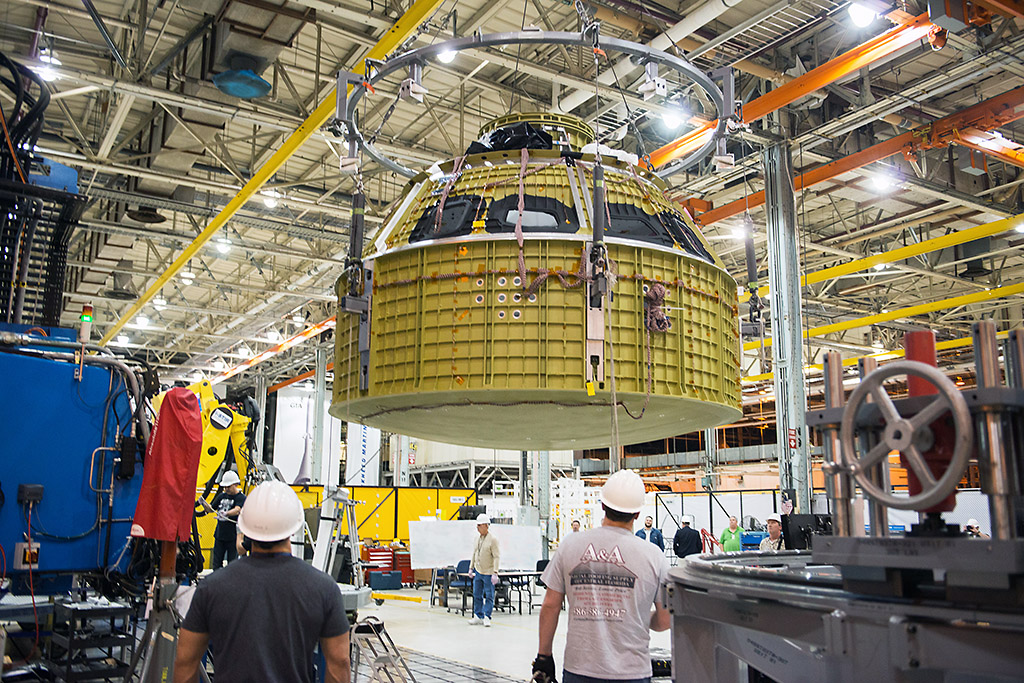
Welding Orion’s seven large aluminum pieces, which began in September 2015, involved a meticulous process. Engineers prepared and outfitted each element with strain gauges and wiring to monitor the metal during the process.
The pieces were joined using a state-of-the-art process called friction-stir welding, which produces incredibly strong bonds by transforming metals from a solid into a plastic-like state, and then using a rotating pin tool to soften, stir and forge a bond between two metal components to form a uniform welded joint, a vital requirement of next-generation space hardware.
“The team at Michoud has worked incredibly hard produce a lightweight, yet incredibly durable Orion structure ready for its mission thousands of miles beyond the moon,” said Mark Kirasich, Orion program manager. “The work to get us to this point has been essential. Orion’s pressure vessel is the foundation on which all of the spacecraft’s systems and subsystems are going to be built and integrated.”
The pressure vessel provides a sealed environment for astronaut life support in future human-rated crew modules. After final checkouts, technicians will prepare the pressure vessel for shipment to NASA’s Kennedy Space Center in Florida in the agency’s Super Guppy aircraft. At Kennedy, it will undergo several tests to ensure the structure is sound before being integrated with other elements of the spacecraft.
The uncrewed Exploration Mission-1 will pave the way for future missions with astronauts. During the flight, in which SLS and Orion will launch from NASA’s modernized spaceport at Kennedy, the spacecraft will venture to a distant retrograde orbit around the moon.
This first exploration mission will allow NASA to use the lunar vicinity as a proving ground to test technologies farther from Earth, and demonstrate it can get to a stable orbit near the moon in order to support sending humans to deep space.