

NASA’s Goddard Space Flight Center
 Greenbelt, MD – The many bright, pinkish clouds in NGC 4700 are known as H II regions, where intense ultraviolet light from hot young stars is causing nearby hydrogen gas to glow. H II regions often come part-and-parcel with the vast molecular clouds that spawn fresh stars, thus giving rise to the locally-ionized gas.
In 1610, French astronomer Nicolas-Claude Fabri de Peiresc peered through a telescope and found what turned out to be the first H II region on record: the Orion Nebula, located relatively close to our Solar System here in the Milky Way.
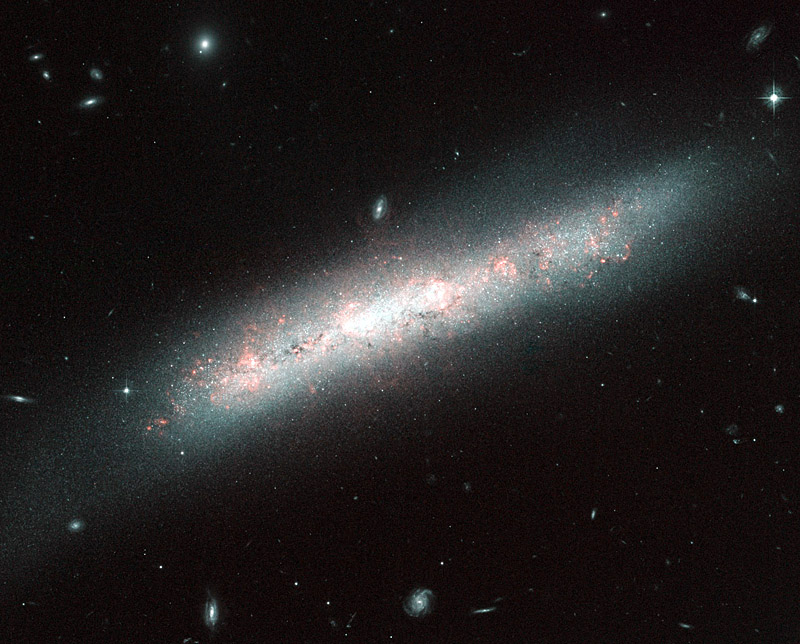
NGC 4700 appears to be an edge-on galaxy. It was discovered back in March 1786 by the British astronomer William Herschel who noted it as a “very faint nebula.” NGC 4700, along with many other relatively close galaxies, is found in the constellation of Virgo (The Virgin) and is classified as a barred spiral galaxy, similar in structure to the Milky Way.
It lies about 50 million light-years from us and is moving away from us at about 1400 km/second due to the expansion of the Universe.