

Written by Dauna Coulter
Science at NASA
 Washington, D.C. – On August 5th at 10:31pm Pacific Time, NASA will gently deposit their new, 2000-pound Curiosity rover on the surface of Mars, wheels-first and ready to roll. Quite a feat – because it will come screaming through the Martian atmosphere at 13,000 mph.
Curiosity, aka the Mars Science Laboratory, will be the largest mission ever to land on another planet. It’s big because it has a big mystery to solve: was Mars ever or is it still capable of harboring life?
“The whole ballgame transpires within 7 minutes, from atmospheric entry to touch-down,” says NASA Jet Propulsion Laboratory’s Steve Sell, Deputy Operations Lead for Entry, Descent, and Landing. “The on board computer calls the shots. And if any one maneuver fails, it’s game over.”
Here’s the game plan.
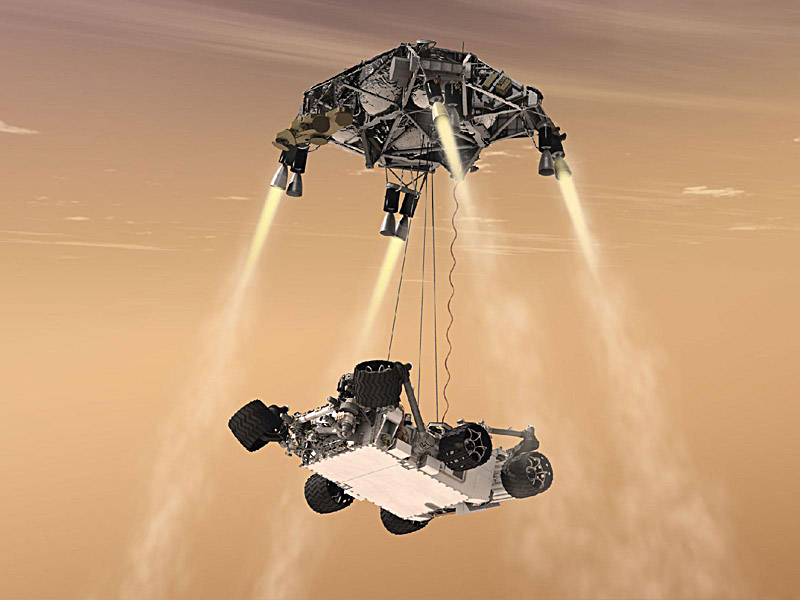
“Atmospheric friction slows the capsule containing Sky Crane — an eight-rocket jet pack attached to the rover — from 13000 to 1000 mph. [Mars’ atmosphere is too thin to slow it more.] The friction burnishes the capsule’s heat shield to a glowing 3800 degrees Fahrenheit (2100 degrees Celsius). Then a 60-foot diameter parachute deploys and inflates above the capsule on 160-foot lines. What’s left of the heat shield jettisons, giving Curiosity its first look at its new home below.”
This is the largest, strongest parachute ever flown to another world. It has to be a super-chute to handle the 65000 pounds of force produced when the rover snaps to attention below it.
“After the payload slows to about 200 mph, explosive bolts free the chute and Sky Crane free-falls for a second. Then its retrorockets fire.”
The rockets slow the descent to 1 ½ mph and power a sideways parry to avoid the faster falling chute. As Sky Crane descends to 60 feet above Mars’ surface, the rover inches down from underneath it on three nylon ropes like a spider spinning strands of its web. With Curiosity dangling 20 feet below, Sky Crane continues its downward progress until the rover is resting on the surface. Explosive bolts cut Curiosity’s last physical attachments to the outside world, and Sky Crane flies away to death-plunge into the red sands, its incredible job done.
It might sound frighteningly complicated, “but what appears to be a complex system actually simplifies the landing greatly,” explains Sell.
Previous missions such as Vikings I and II and the Mars Phoenix Lander used retrorockets to lower spacecraft all the way to the surface atop a legged lander. Others have used airbags. Neither method is feasible for Curiosity.
“With a payload this size, the rockets could kick up enough dust to compromise the rover and its instruments,” explains Sell. “And the rockets could excavate craters Curiosity would have to avoid as it drives away. Add to that the risk of a big, heavy vehicle driving down off the lander via an exit ramp to reach the surface.”
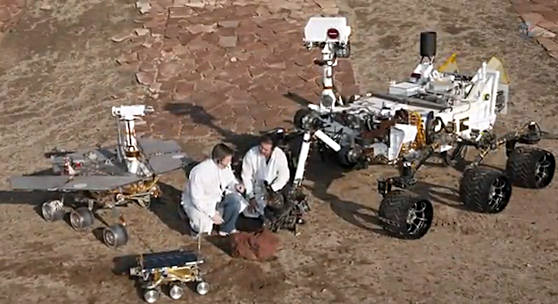
Pathfinder, Spirit, and Opportunity used airbags to eliminate these concerns. But Curiosity is too large for airbags.
“Bags big enough to soften its landing would be too heavy or too costly to launch. Besides, you’d have to drop the payload so slowly for the bags to survive the load, you may as well place the rover right on its wheels.”
Sky Crane, says Sell, makes sense for Curiosity. But it still keeps him up at night.
“I leave myself voice mails in the middle of the night about things to check in the morning. We’ve run thousands of tests and simulations, thinking of ways to ‘break’ the system so we can build in comfortable performance margins. We’re still testing. There’s always one more test we can run. We’re always afraid we missed something.”
In the control room at JPL the night of August 5th, it will be too late. It takes 14 minutes for signals to travel from Mars to Earth. When the team receives the signal ‘I am entering the atmosphere,’ Curiosity will be alive or dead on the surface.
Says Sell: “I’m already holding my breath.”